The Vent You Have Stopped Seeing: Five Plumes Every Plant Has, and the Three That Pay
Condensate drum, open condensate tank, process flash, blowdown tank and deaerator vent: how to tell which plume pays for equipment and which is fixed with a setting first.
On this page
Every steam plant has the same five plumes: the condensate drum, the open condensate tank, the flash off a high-pressure process, the blowdown tank and the deaerator vent. A few months on site and nobody sees them any more. Three of them pay for equipment. The other two are fixed with a setting first, and recovering them before that spends money on the wrong thing.
To put a rupee figure on one plume, use the four steps in pricing your condensate tank’s flash. This post is about telling the five apart on a walk round the plant.
The three tests
Every plume gets the same three questions:
- Does it run every hour, or only in bursts?
- Is something buying steam it could replace? A user at or below the plume’s pressure, or a user above it plus a high-pressure main to lift the flash there.
- Is it big enough to pay for a vessel, a pipe or a Jetomat?
1. The condensate drum vent: pays
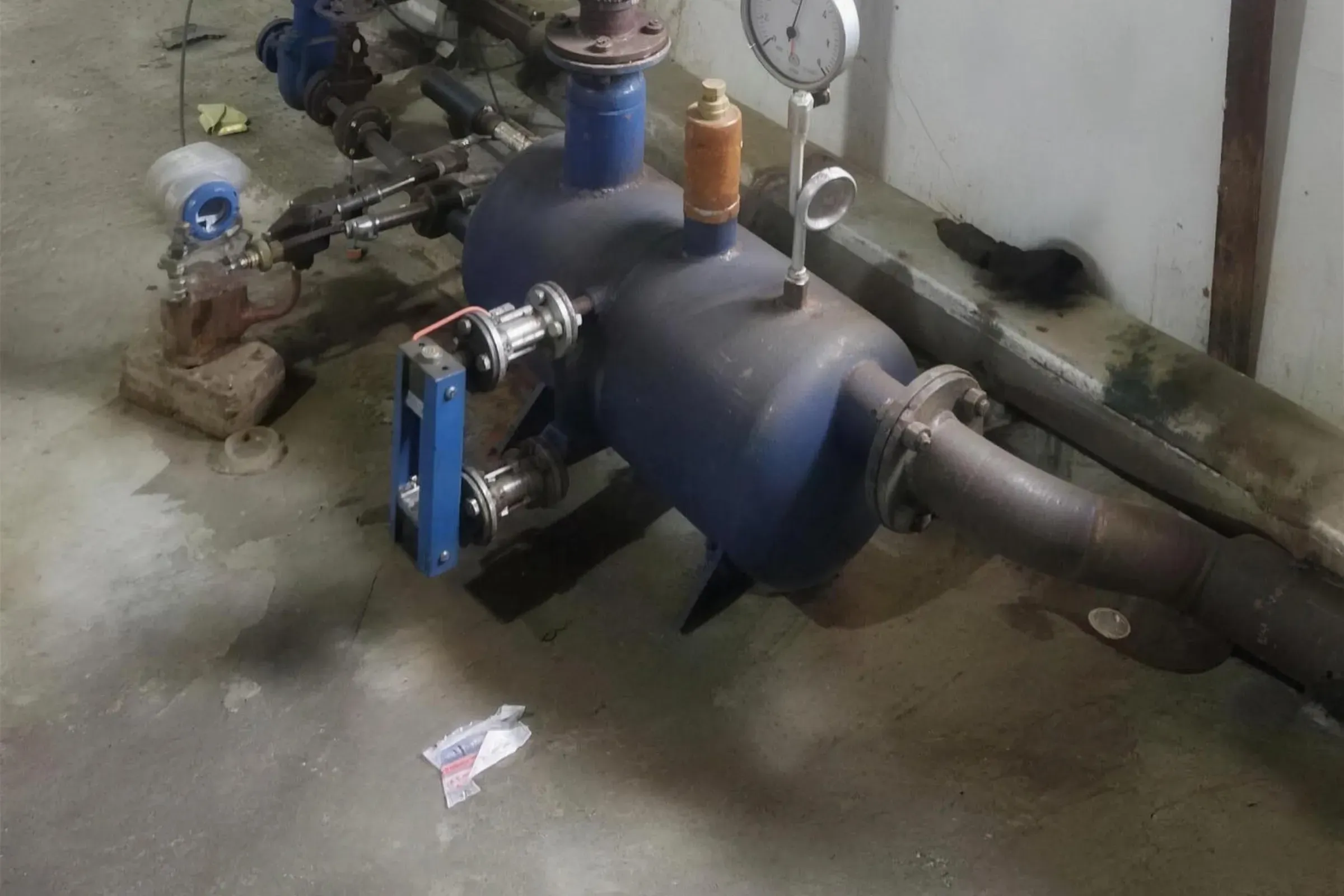
At a process plant in South Korea, condensate collected in a drum and flashed as its pressure fell. 1,500 kg/h of flash went up the drum vent as a white plume. A variable-nozzle Jetomat DN 150, driven by 12.5 bar g steam, now draws that flash off at 0.2 bar g and delivers it into the plant’s 1.56 bar g LP header: 1.1 t/h recovered, about Rs 3.8 crore a year as calculated by the plant. The Korean case is here.
All three tests pass: a steady plume, a header buying steam every hour, a flow in tonnes.
2. The open condensate tank: pays
A food factory’s trap condensate collected in a 15 m³ tank that had stood open for 50 years. The steam it re-evaporated, at about 100 °C and 0.1–0.2 bar g, escaped, while the deaerator took all its heating steam from the 10 bar g main. The tank was closed. A motorised Jetomat on the 10 bar g main now draws the tank’s steam out and heats the deaerator, whose pressure controller (set point 0.25 bar g) sets the nozzle. The reported saving is about Rs 10.6 lakh a year. The food-factory case is here.
The deaerator is the user every plant already has, and it runs whenever the boiler does. That is why this plume pays even at a fraction of a bar.
3. The flash off a high-pressure process: pays
An industrial laundry in Spain had two processes at 10.5 bar g, using 652 and 559 kg/h of steam. Their condensate flashed and nothing used the flash, while a 4 bar g user took 326 kg/h straight from the boiler. A recompression skid now flashes that condensate at 2.5 bar g and a Jetomat lifts the flash to 4 bar g. Boiler steam to the user fell to 208 kg/h (−36 %), and the skid’s panel logged 287 t of steam saved in the first four months. The laundry case is here.
The figures pass a steam-table check. Condensate falling from 10.5 to 2.5 bar g flashes about 9.6 %, so 1,211 kg/h gives about 116 kg/h of flash. Boiler steam to the user fell by 118 kg/h. Run the same check on any proposal you are given; it is the first test in how to check a steam-saving proposal.
4. The blowdown tank: a setting first
Continuous blowdown leaves the boiler at boiler temperature, and from about 10 bar g roughly 16 % of it flashes at an atmospheric blowdown vessel. That makes the plume look worth catching. But how much blowdown there should be is set by the water, not by the valve: blowdown % = feed TDS ÷ (boiler TDS limit − feed TDS), as Blowdown and TDS control works through.
One audit of a 2 t/h boiler at 10.5 bar g found manual blowdown estimated at 3,150 kg a day, against the 484 kg a day its water needed. With the rate held by TDS control, the flash from what was left came to about 3.3 kg/h: too small for a stand-alone flash vessel to pay. The saving was in the setting.
A blowdown flash vessel pays where the controlled blowdown is still large: big boilers, high feed TDS, little condensate return. Even then it is a vessel and a pipe to the feed tank, not a Jetomat.
5. The deaerator vent: a setting, and sometimes a symptom
The deaerator has to vent. The wisp is the oxygen and carbon dioxide leaving, and about 0.1 % of the deaerator’s throughput is the right size (Feedwater and deaeration). No plume means the gases are going to the boiler. A roaring plume means fuel is leaving through the roof. Set the valve to a whisper; where even the wisp matters, a small vent condenser hands its heat to the incoming make-up.
A roaring feed-tank vent often has a second cause: the tank is full of heat. A vented tank can absorb at most feed flow × (100 − make-up temperature) kcal/h, and everything beyond that vents. Audits have also found deaerator heads with the make-up and condensate piped straight into the tank, past the head, so the flash sent to the head simply vented. Either way, sending plume 1 or 2 into that tank moves the plume, it does not recover it. The food factory’s recovery works because its deaerator was buying live steam that the tank’s steam now replaces.
The rule under all five
A plume pays when the recovered steam replaces steam somebody is buying today. The Korean LP header, the food factory’s deaerator and the laundry’s 4 bar g user were all buying it. Where no such user exists at a reachable pressure, the right answer may be a vent condenser into cold make-up, or an honest vent; the Academy lesson on recovery schemes maps the choice. For the blowdown tank and the deaerator vent, make the plume smaller first, then see if what is left is worth a vessel.
What we need from you
For each plume you can see: where it comes from, the pressure or condensate temperature feeding it, a rough flow (or the condensate flow behind it), the pressure of your nearest users and headers, your motive main pressure, and your boiler TDS figures with the deaerator vent setting. We will tell you which of the five is worth equipment.
FAQ
Should every plume on the plant be recovered?
No. A plume pays for equipment when it runs every hour, is big enough, and replaces steam a user is buying today. The blowdown tank and the deaerator vent usually need a setting first: blowdown to the TDS figure, the vent valve to a whisper.
Why is the deaerator vent never closed completely?
The vent is where the oxygen and carbon dioxide leave. A steady wisp of about 0.1 % of the deaerator's throughput is the price of deaeration. Shut it and the gases go to the boiler.
Is blowdown flash worth recovering?
Set the blowdown rate by TDS first; that is the bigger saving. On one small 2 t/h boiler the flash left after automatic TDS control was about 3 kg/h, too small for a flash vessel to pay. On large boilers with a high blowdown rate it can pay, as a flash vessel feeding the feed tank.