
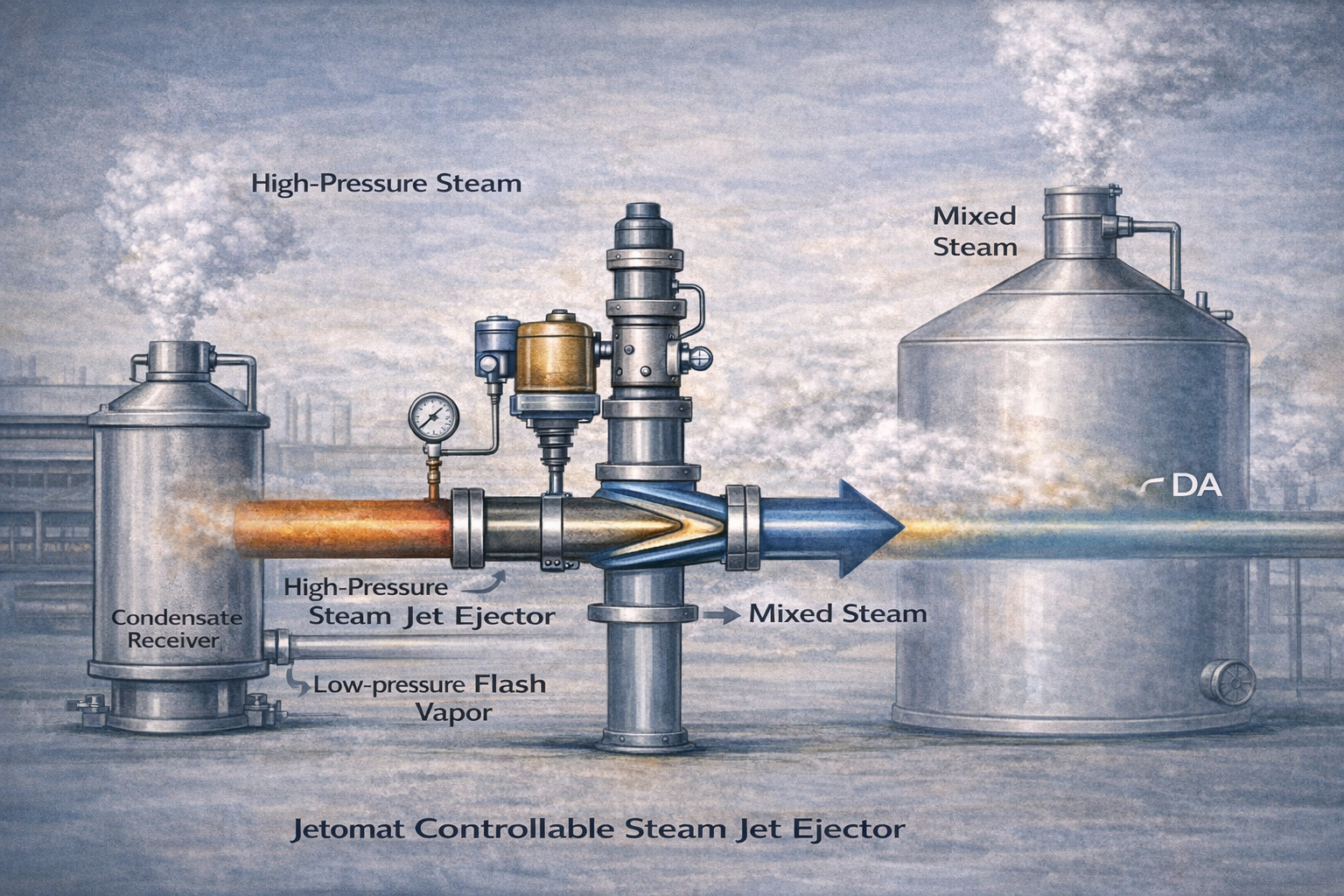
Feedwater Heating with Ejectors: Improving Deaerator Efficiency
Jetomat ejectors improve deaerator/feedwater efficiency by capturing vented flash steam from condensate receivers and recompressing it into usable mixed steam for DA heating, reducing boiler firing and eliminating roof plumes.
Recovered vapor typically displaces fresh DA heating steam nearly 1:1, cutting fuel, make-up water, and chemical dosing with simple pressure/temperature control and low maintenance.
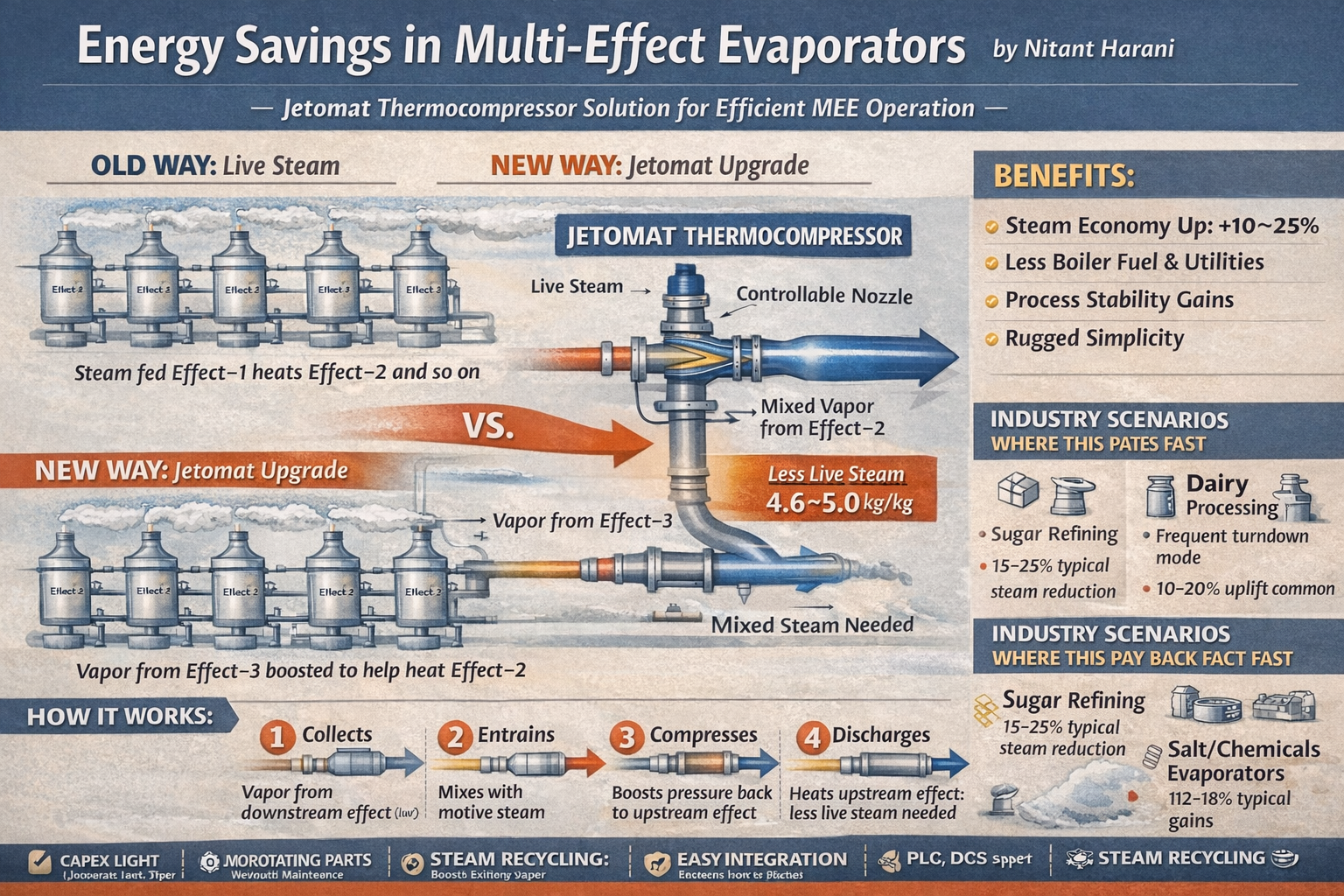
Energy Savings in Multi-Effect Evaporators
Jetomat thermocompressors improve multi-effect evaporator steam economy by recompressing lower-pressure vapor from a downstream effect and reusing it as heating steam for an upstream effect—reducing live steam demand without adding a new effect.
Typical outcome is ~10–25% better steam economy (less boiler firing, water/chemical use, and venting) with stable control and low maintenance because there are no rotating parts.
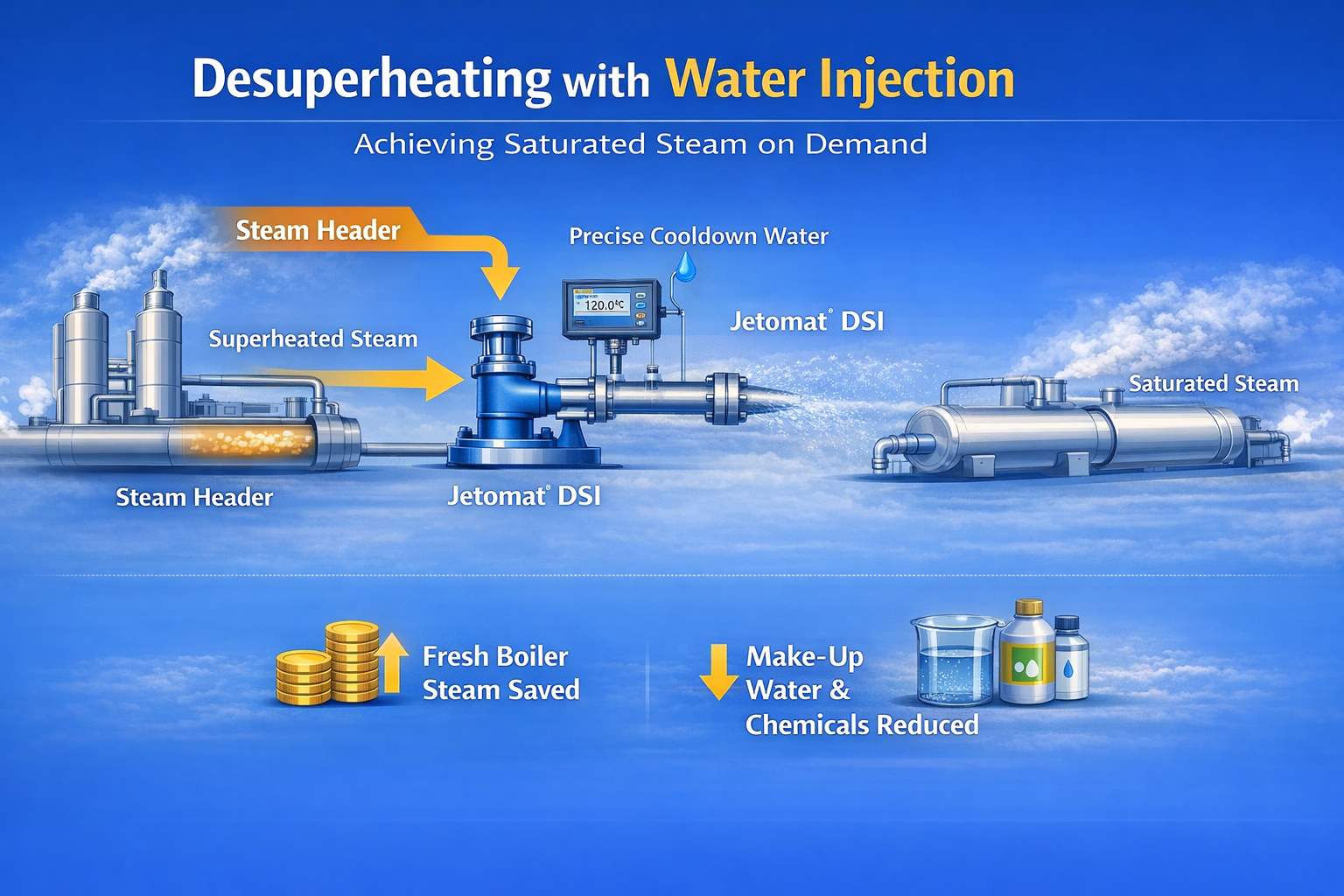
Desuperheating with Water Injection – Achieving Saturated Steam on Demand
Jetomat 591 converts superheated steam into saturated (or slightly wet) steam by combining stable pressure control with precise water injection, so the outlet stays at the saturation temperature for that pressure.
This prevents hot spots and drips in textile steamers and similar users, delivering fast response and uniform heat transfer with typically ~3–5% injection water and tight temperature control.
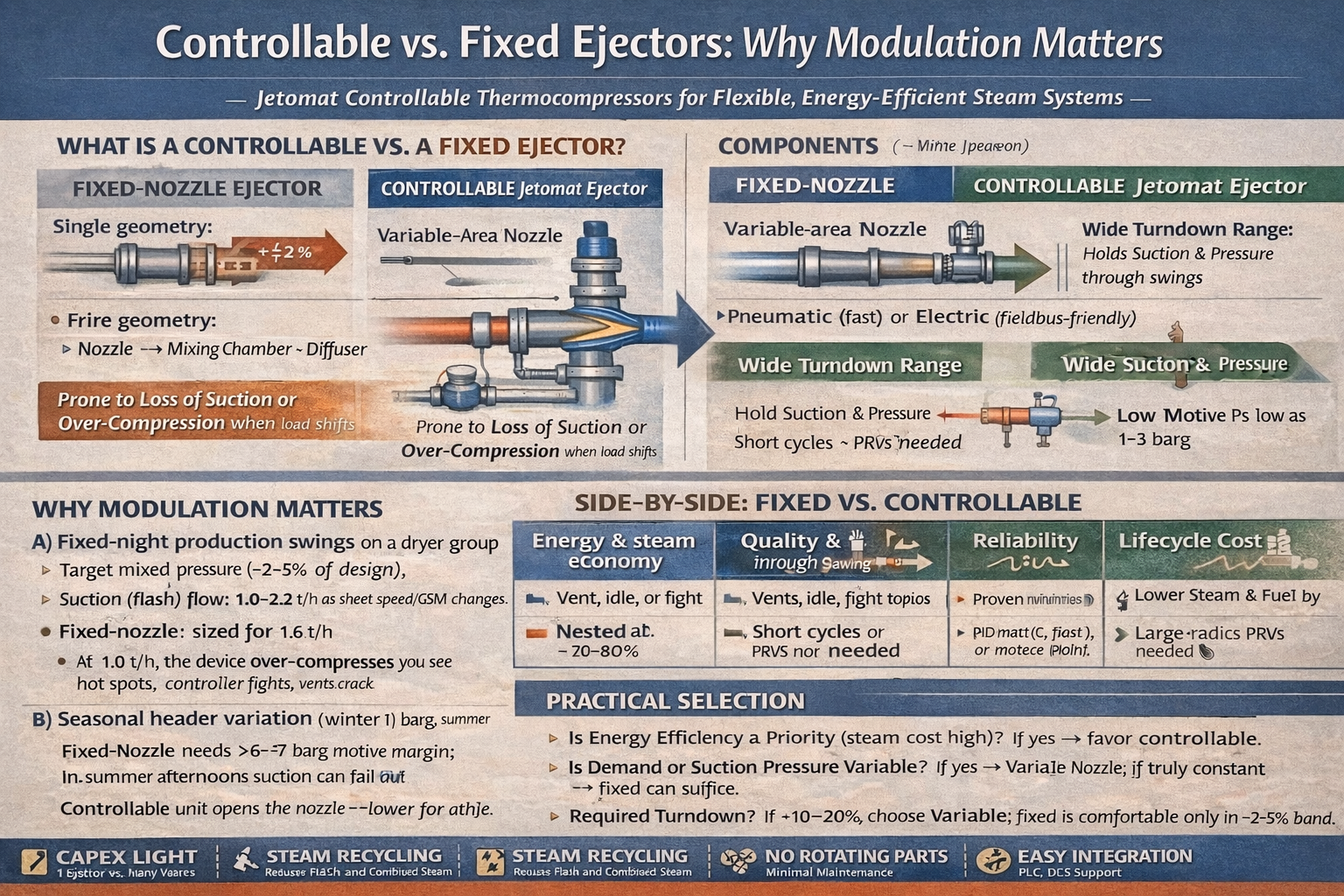
Controllable vs. Fixed Ejectors: Why Modulation Matters
Fixed ejectors work well only at one design point; off-design they can lose suction or over-compress, forcing bypass and wasting steam.
A controllable Jetomat modulates the motive nozzle to hold mixed pressure and suction stable across wide turndown (about ~10–15% to 70–80% vs ~2–5% for fixed).
Result: consistent flash-steam recovery and better efficiency during real load/header swings.
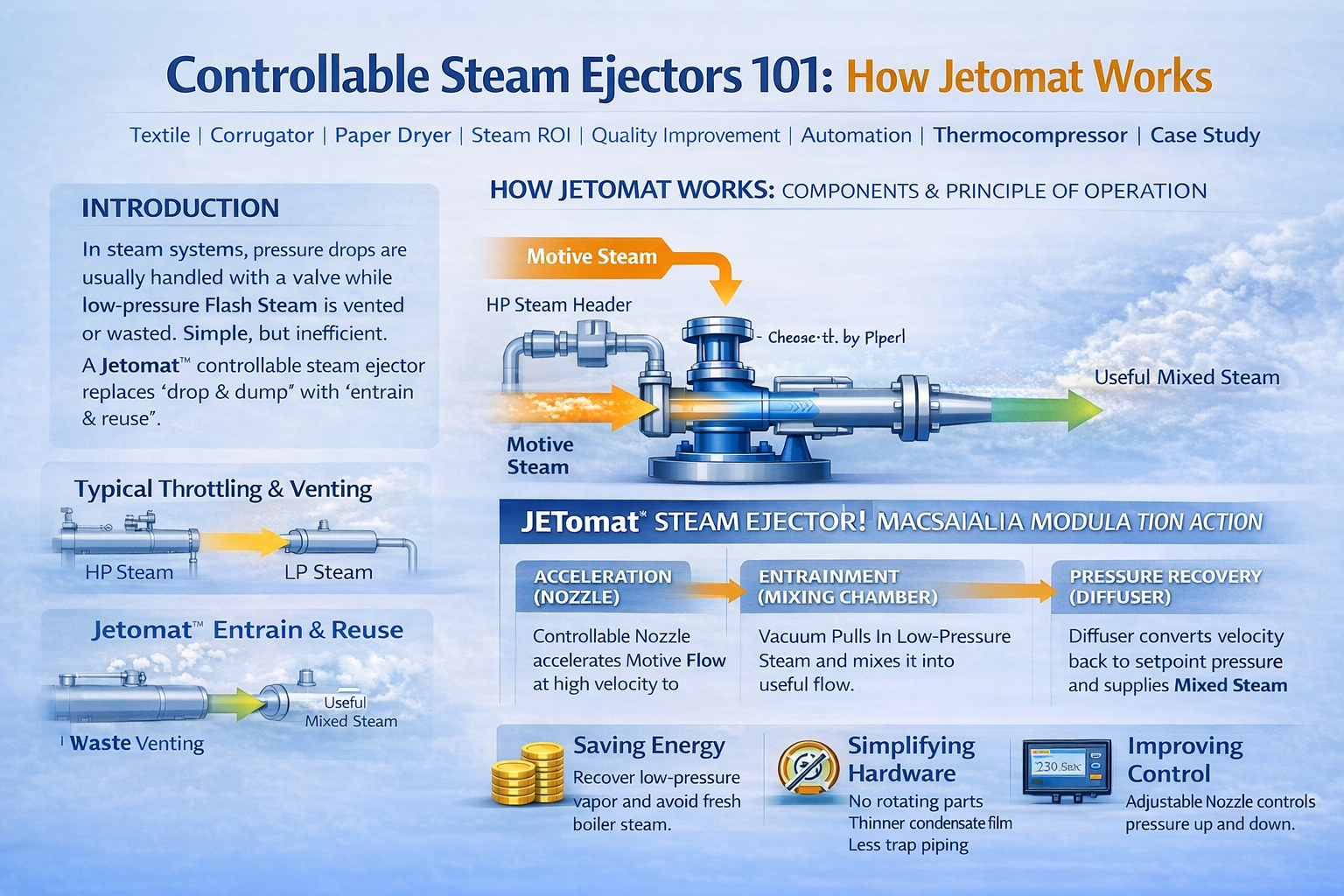
Controllable Steam Ejectors 101: How Jetomat Works
Jetomat is a controllable steam ejector that uses high-pressure motive steam to create suction, entrain low-pressure flash/vent steam, and recover pressure in a diffuser to deliver stable mixed steam—no rotating parts.
By modulating the nozzle, it holds pressure under load swings and reuses wasted vapor, reducing steam/fuel use versus PRV throttling.
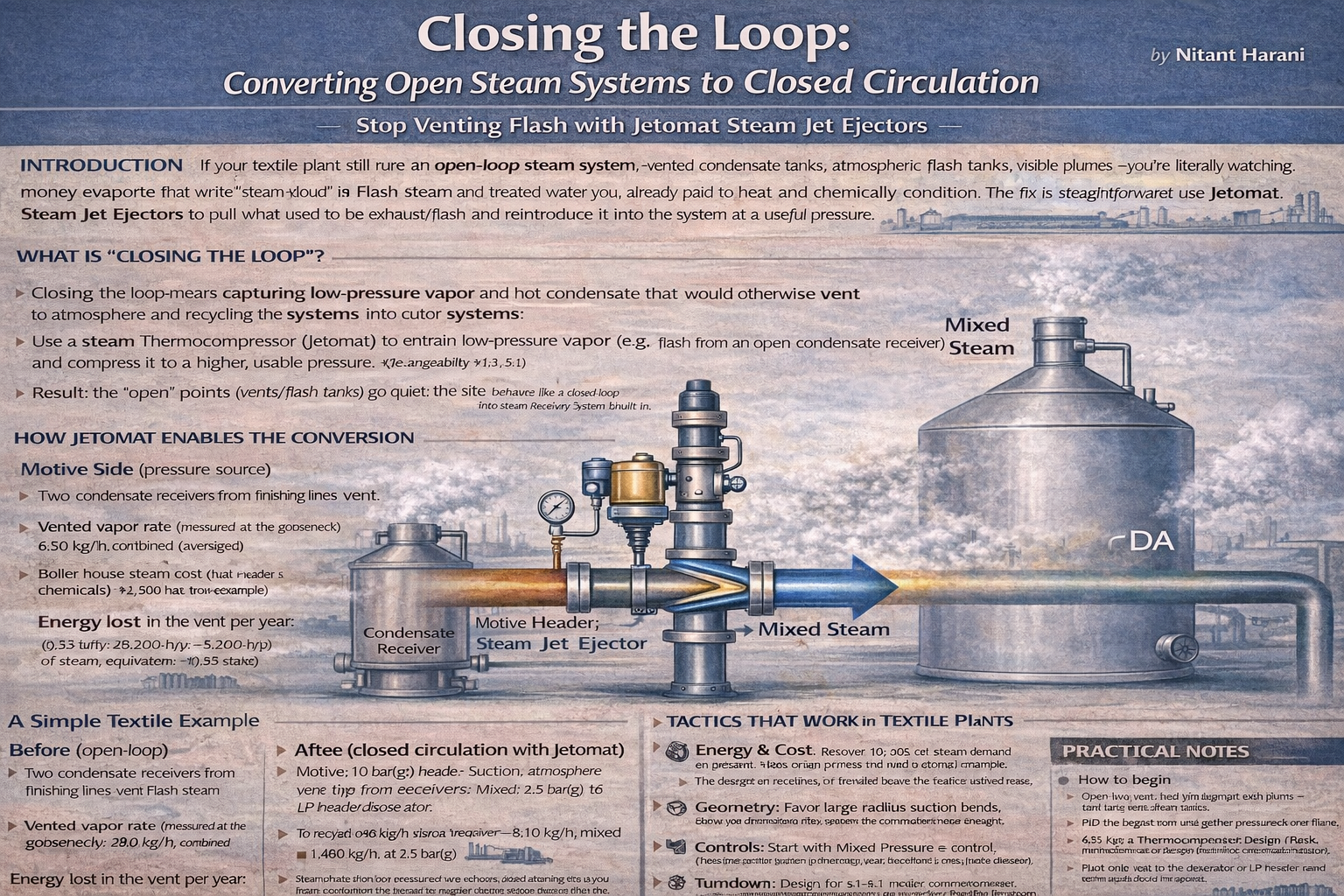
Closing the Loop: Converting Open Steam Systems to Closed Circulation
If your textile plant still runs an open-loop steam system—vented condensate tanks, atmospheric flash tanks, visible plumes—you’re literally watching money evaporate. That white “steam cloud” is Flash Steam and treated water you already paid to heat and chemically condition. The fix is straightforward: use Jetomat Steam Jet Ejectors to pull what used to be exhaust/flash and reintroduce it into the system at a useful pressure. This post walks through how to convert open systems to closed circulation, cut venting to near-zero, and reduce make-up water and chemicals—without adding rotating machinery.
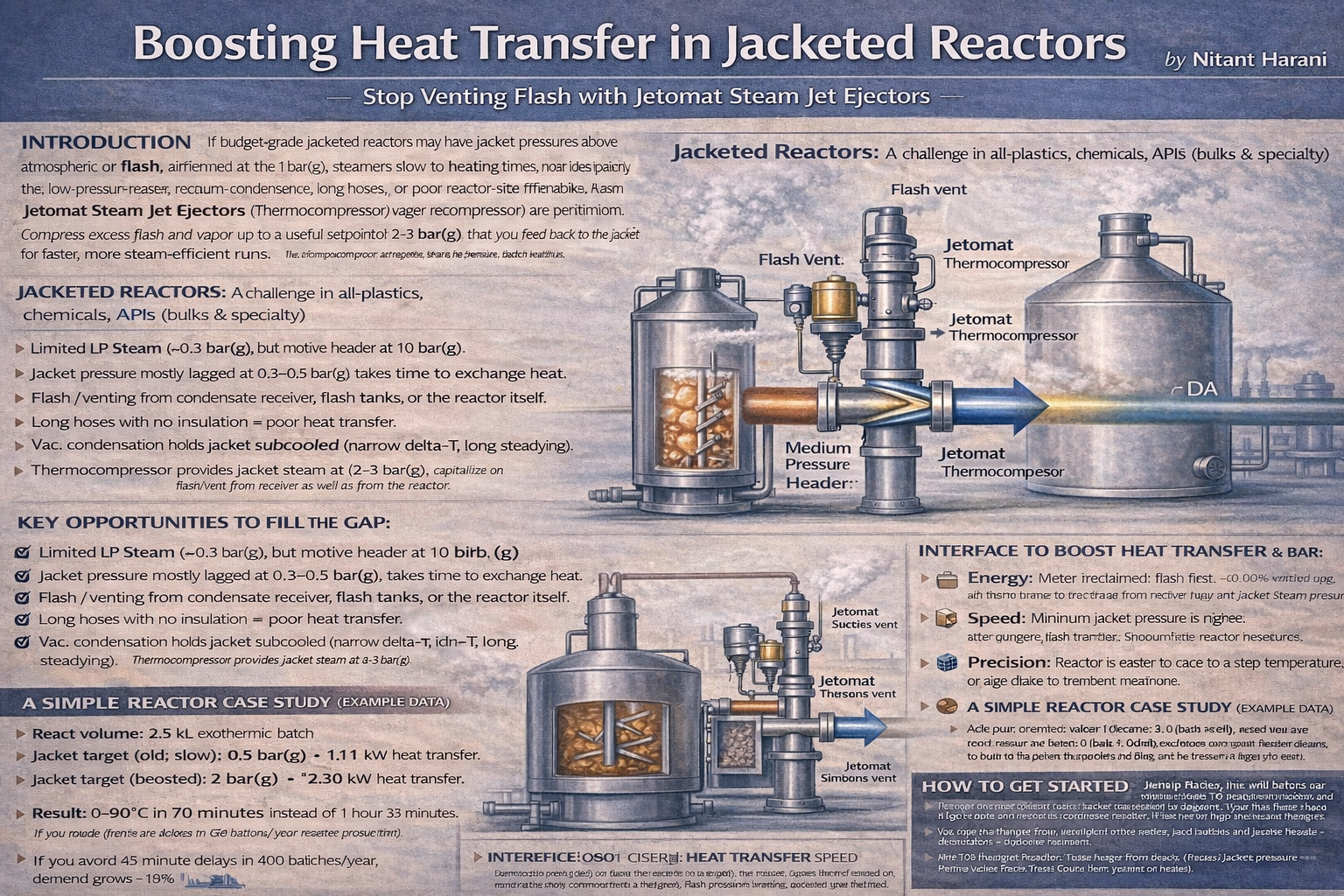
Boosting Heat Transfer in Jacketed Reactors
Jetomat ejectors boost jacketed reactor heat transfer by continuously recirculating steam/condensate, stripping the condensate film that insulates the jacket wall and stabilizing jacket pressure/temperature.
In the case example, U increased ~25%, enabling 15–20% faster heat-up or ~25% more batch throughput with similar batch energy—so energy per kg of product dropped.
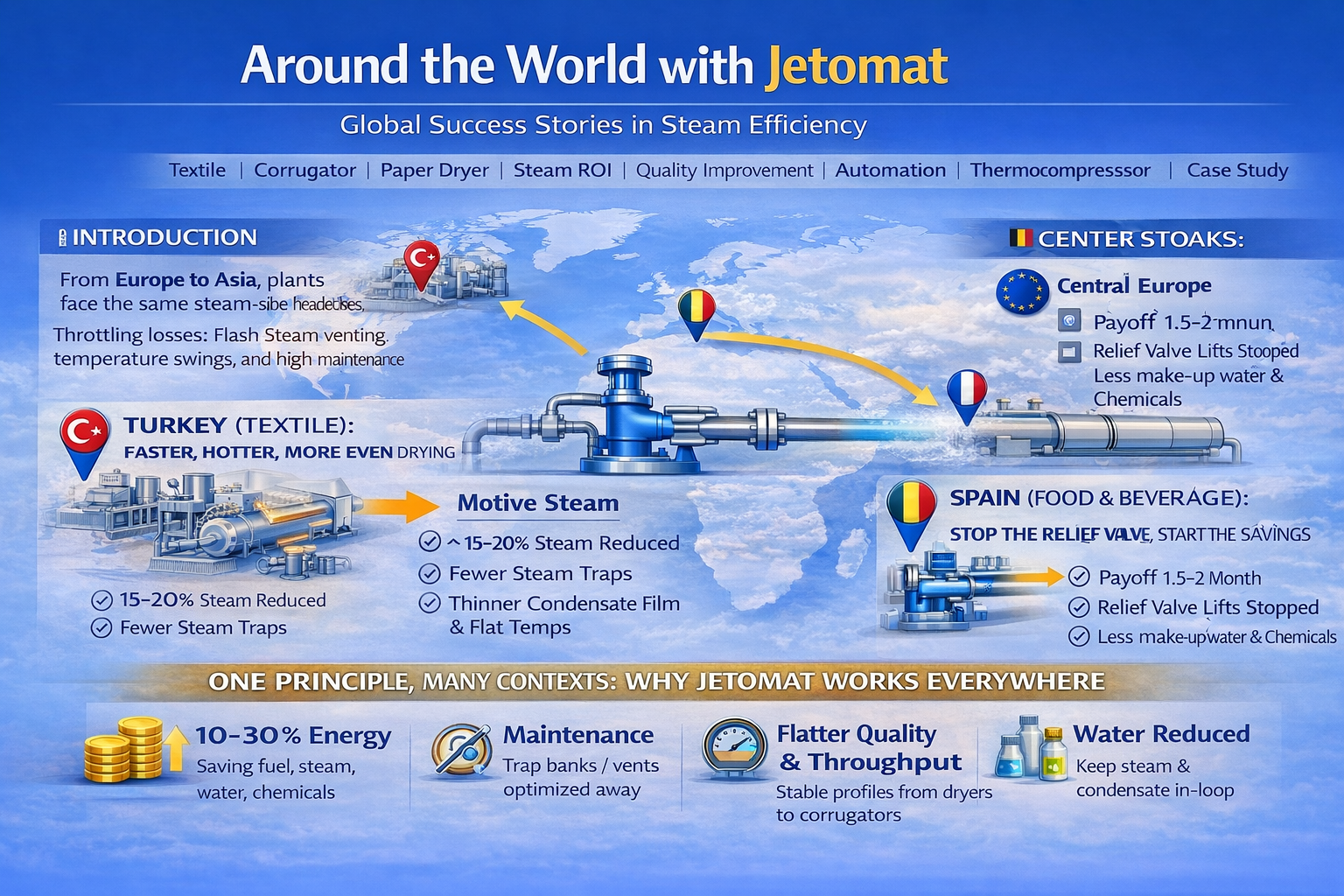
Around the World with Jetomat: Global Success Stories in Steam Efficiency
Jetomat thermocompressors reuse flash/return steam instead of throttling and venting, typically reducing steam/fuel use by ~10–30% while stabilizing temperature control.
Across textiles, corrugators, food, and paper, sites also report fewer traps/maintenance, lower plumes, improved quality (warp/moisture), and fast payback when vent losses are stopped.
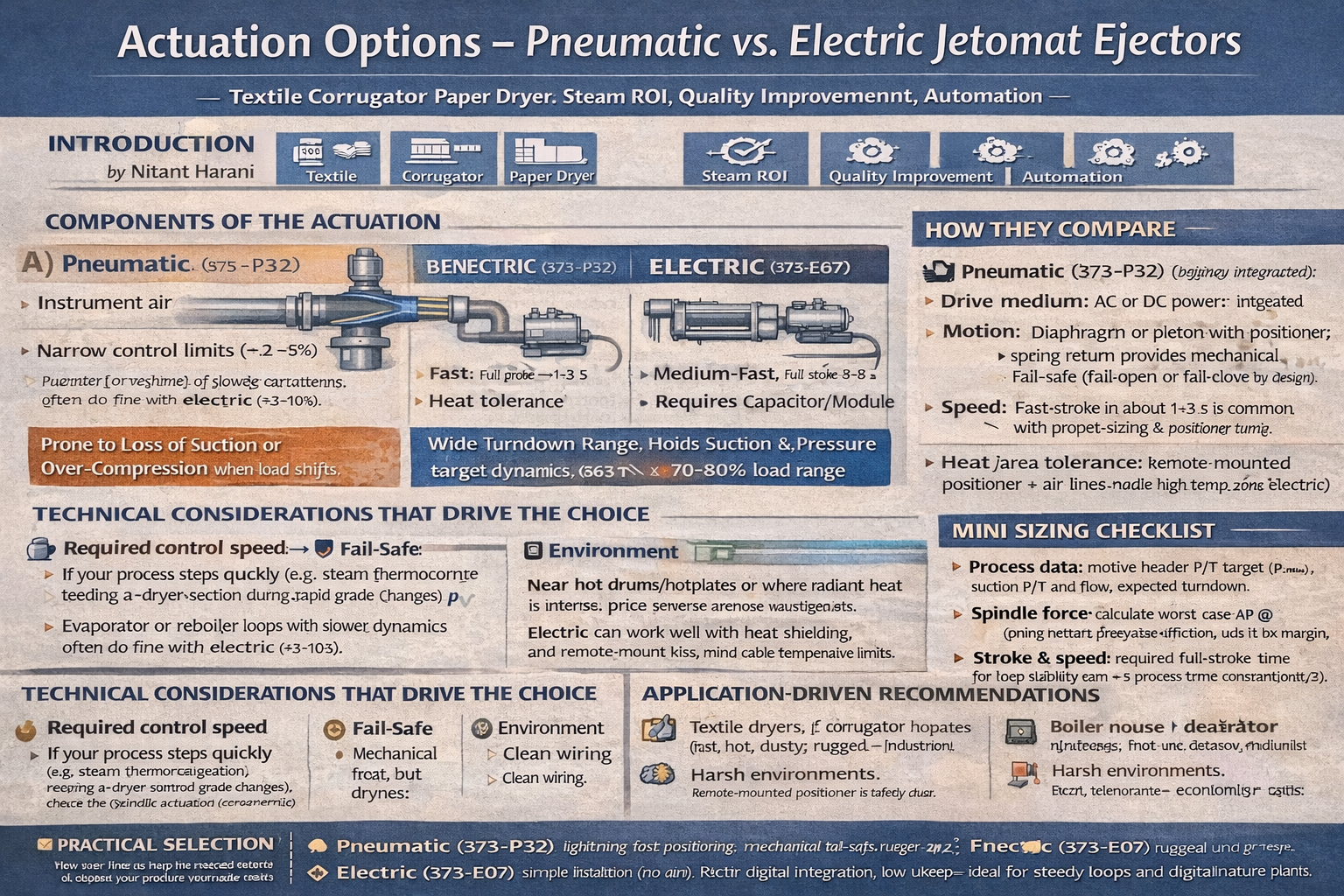
Actuation Options – Pneumatic vs. Electric Jetomat Ejectors
This blog compares pneumatic vs. electric actuation for controllable Jetomat ejectors, explaining how actuator speed and positioning accuracy directly affect entrainment stability, mixed-steam pressure, and energy recovery.
Pneumatic suits fast, high-heat, fail-safe-critical loops (quick spring-return response), while electric suits sites prioritizing simple wiring, digital/fieldbus integration, and where instrument air is limited.
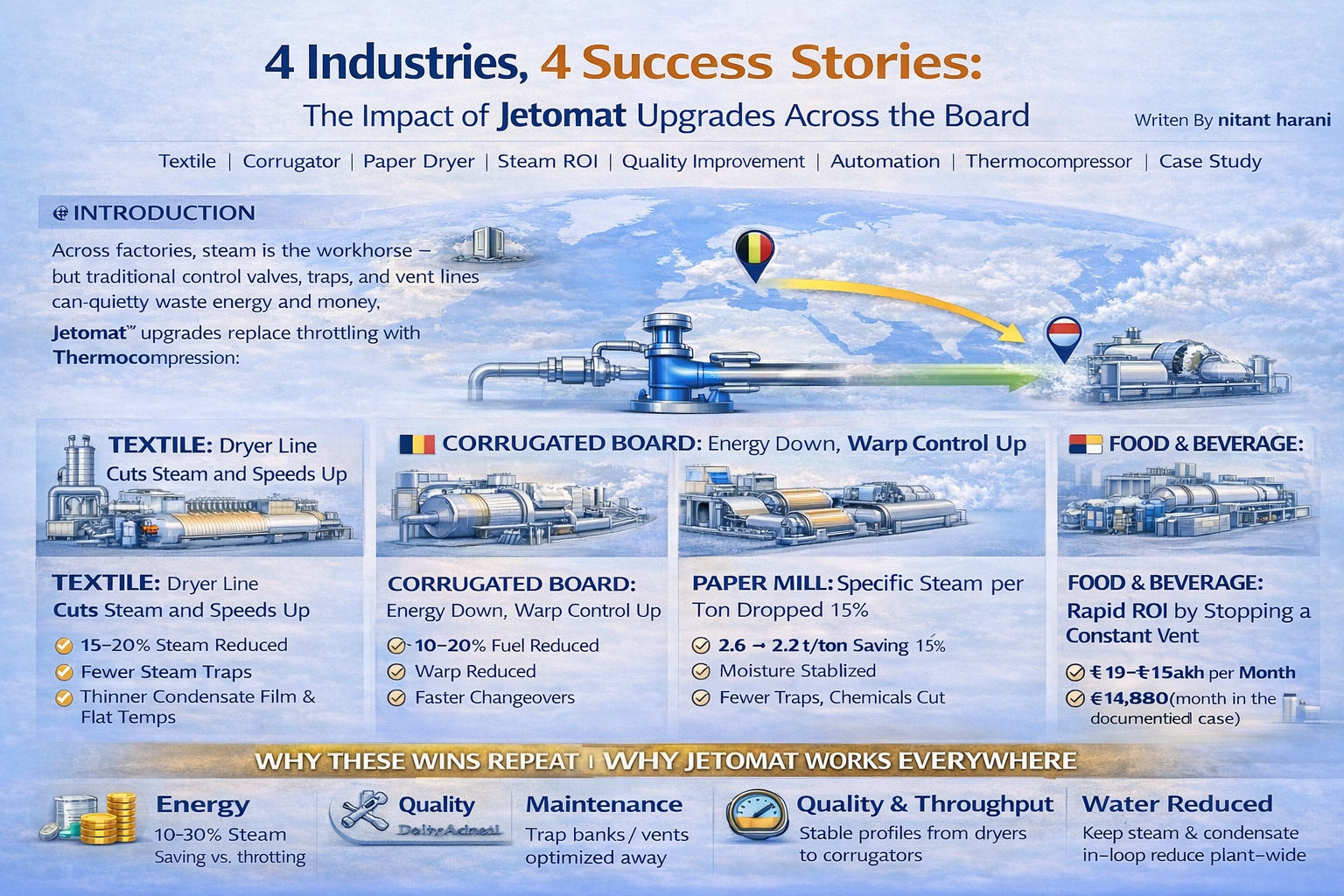
4 Industries, 4 Success Stories: The Impact of Jetomat Upgrades Across the Board
Jetomat upgrades replace throttling with thermocompression—recovering flash/return steam and reusing it—so plants typically see ~10–30% steam/fuel savings with steadier temperature control.
Across textile, corrugated, paper, and food plants, this also reduces traps/vents and improves quality (uniform drying, less warp) with fast payback where venting losses exist.
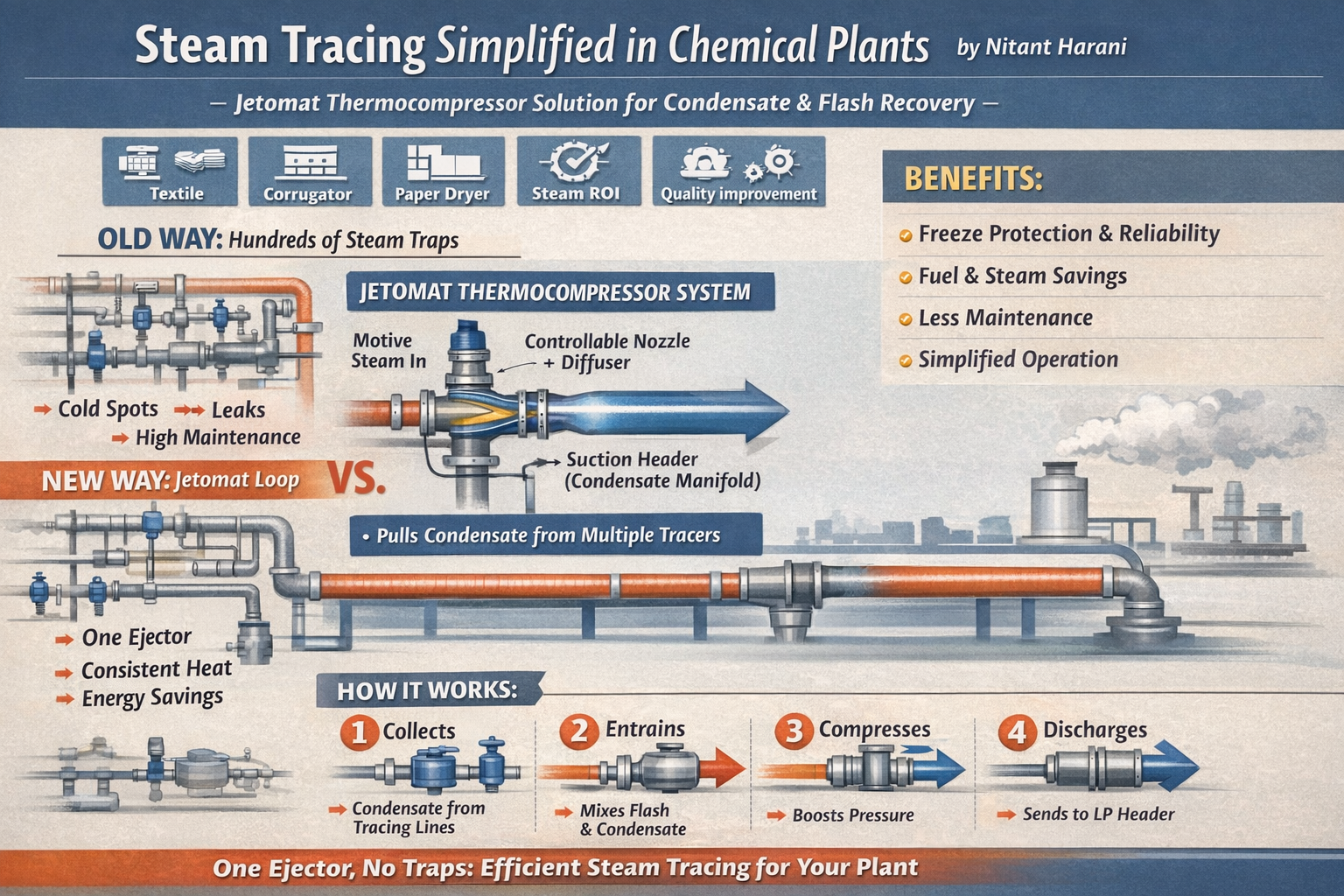
Steam Tracing Simplified in Chemical Plants
Jetomat simplifies steam tracing by replacing dozens of small traps with one controllable steam ejector that continuously pulls condensate from multiple tracing lines into a central return header.
This keeps tracers hot and dry (reliable freeze protection, fewer cold spots), reduces leaks and maintenance in pipe racks, and saves steam by eliminating trap failures and reusing flash steam.
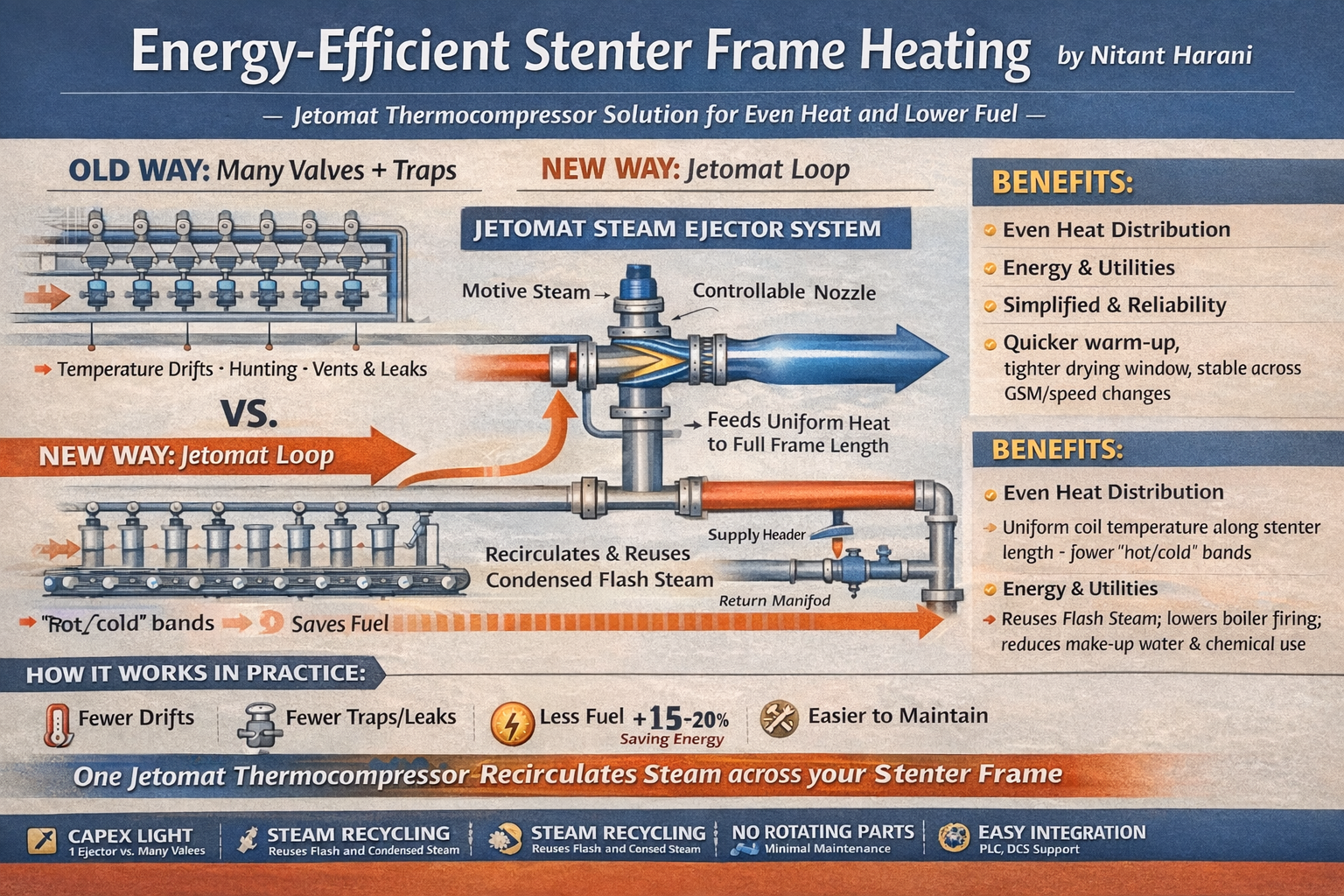
Energy-Efficient Stenter Frame Heating
Jetomat improves stenter heating by replacing “one valve + one trap per zone” with a single recirculating steam ejector loop that reuses flash steam and continuously clears condensate from all zones.
This keeps coil temperatures more uniform and responsive (typically ±1–2 K), reduces trap/valve maintenance, and commonly delivers ~15–20% steam/fuel savings while improving drying consistency and allowing higher line speeds.
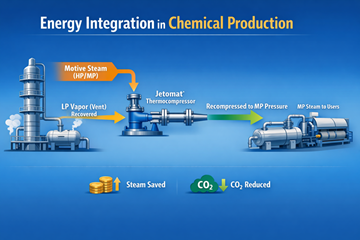
Energy Integration in Chemical Production
Jetomat enables energy integration in chemical plants by recompressing low-pressure waste vapor (from column vents/flash steam) using a small amount of high-pressure motive steam, then supplying that mixed steam to medium-pressure users like reboilers and dryers.
This converts vent losses into usable heat, typically cutting boiler steam/fuel, reducing CO₂ and visible plumes, and improving pressure/temperature stability with low maintenance since there are no rotating parts.
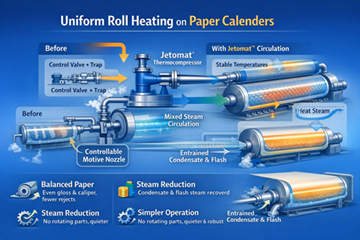
Uniform Roll Heating on Paper Calenders
Jetomat thermocompressors create a circulating steam loop in paper calender rolls, actively pulling condensate/flash steam through the roll so the shell stays uniformly hot during low loads and speed/grade changes.
This reduces gloss bands and caliper variation by stabilizing roll temperature, while also cutting steam losses by reusing flash steam—typically improving quality and saving energy versus valve + trap control.
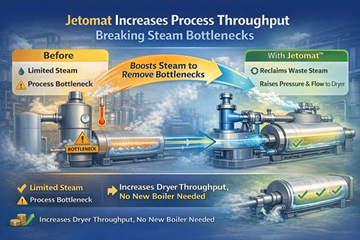
Jetomat Increases Process Throughput Breaking Steam Bottlenecks:
Jetomat thermocompressors help plants break “steam bottlenecks” by boosting usable steam pressure/flow using recovered low-pressure or flash steam—without adding a new boiler or major piping upgrades. This debottlenecks steam-limited equipment (dryers, stoves, spray dryers), enabling higher throughput (often 3–10%+) while reducing live steam demand. The result is more production from the same steam infrastructure, with fast payback and added reliability.
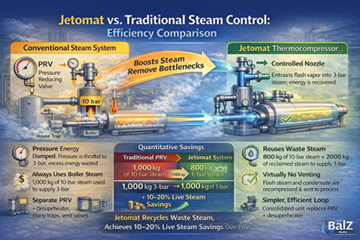
Jetomat vs. Traditional Steam Control: Efficiency Comparison
Traditional steam control uses PRVs to drop pressure and often vents unused/flash steam—so energy is dissipated and fuel is wasted.
Jetomat achieves the same pressure control by using the pressure drop to entrain low-pressure/flash steam, recycling what would be vented.
Result: typically lower live steam demand, less venting, and better overall efficiency.
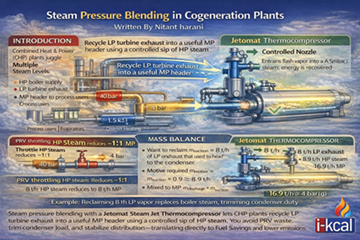
Steam Pressure Blending in Cogeneration Plants
Steam pressure blending in CHP plants uses a Jetomat thermocompressor to mix HP boiler steam with LP turbine exhaust, delivering stable MP steam while recycling vapor that would otherwise go to the condenser.
Compared to PRV throttling, it converts pressure drop into useful work (entrainment), reducing boiler fuel/CO₂, lowering condenser load, and improving MP header stability without adding a new boiler.

Sustainability Wins: How Jetomat Cuts Energy Loss & Emissions
Jetomat thermocompressors help plants meet energy-efficiency and climate targets by recovering waste steam, reducing boiler fuel demand and delivering measurable CO₂ cuts. By minimizing steam venting, they also reduce water loss, treatment chemical consumption, and related boiler-house electricity use—improving both sustainability metrics and operating costs.