
Trap Sense
Find the steam traps that leak, block or flood, while the plant keeps running. Senseven’s Trap Sense listens to each trap through a smartphone and an acoustic sensor, reads it with the trap’s temperatures, and gives the result on the spot. Valve Sense, on the same kit, finds valves that leak inside.
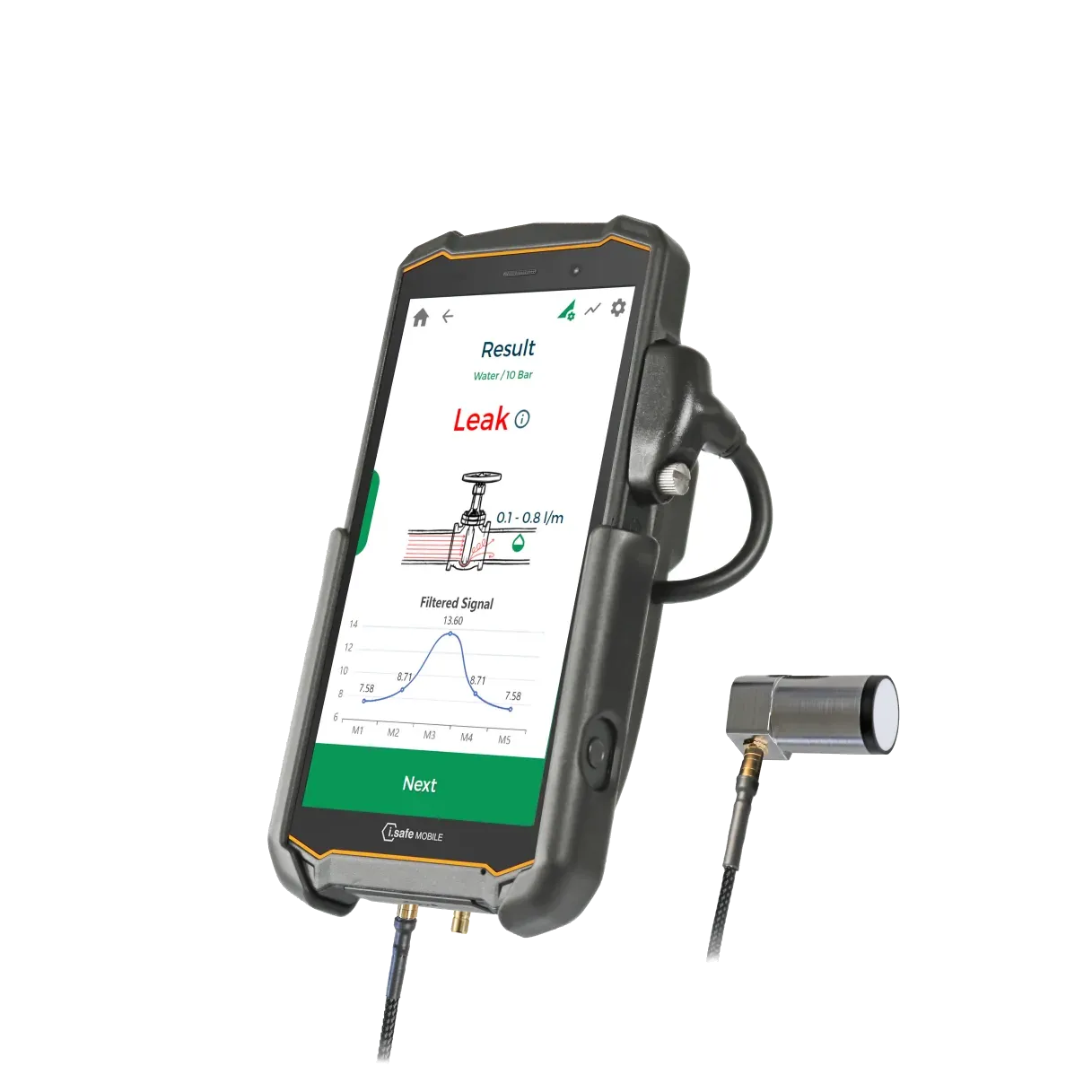
- 190Steam traps tested in 4 days at a chemical plant
- 24%Found faulty: 45 traps
- Rs 59 lakh/yrSteam lost through the leaking traps (our estimate)
In the case
What is included in the Trap Sense and Valve Sense package?
A complete package of hardware and software, shipped in a hard product shell case.
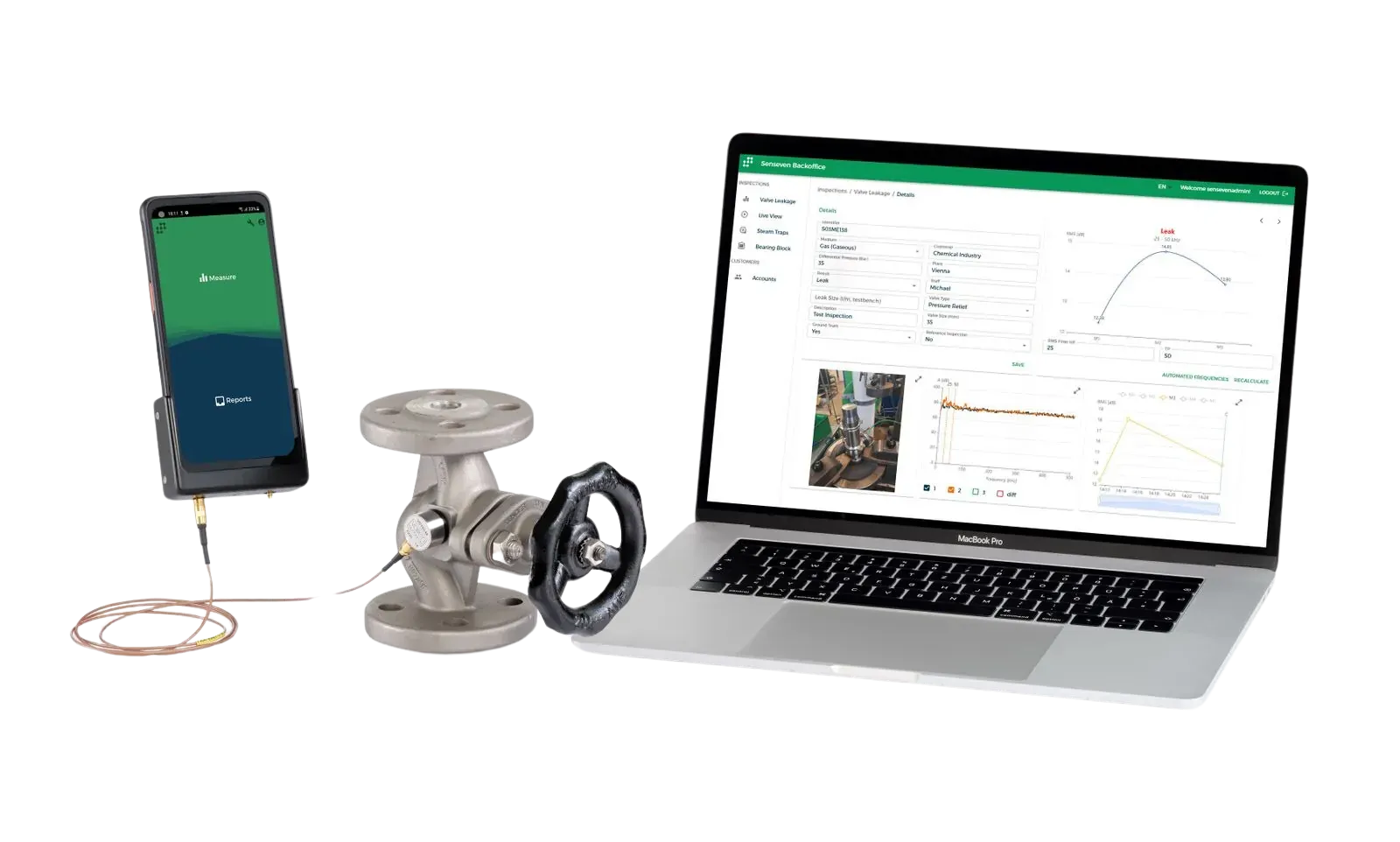
- Smartphone with the Senseven app
- Acoustic emission sensor
- Valve
- Senseven back office
- Smartphones Rugged smartphones (Samsung, and i.safe MOBILE for Ex areas)
- Measuring technology The measuring systems are adapted to the smartphones.
- Acoustic emission sensors Acoustic emission testing is a non-destructive test technique that detects high-frequency stress waves emitted by changes in materials or structures under load.
- Waveguide A waveguide for hot and cold surfaces
- Senseven app The Senseven app for testing steam traps and finding internal leaks in valves
- Senseven back office Access to the Senseven back office for structured storage of all measurement data, automated reporting and further analysis
The problem
Today's non-destructive testing options are…
-

Complex to use & error-prone
-

Use proprietary & closed devices
-

Require time-consuming analysis
-

Need a trained & experienced engineer
Current practice
How do plants check their steam traps today?
Many plants never test their traps: a failed trap shows only when a line floods or a plume of steam appears.
CostlySome take traps off the line to check them on a bench.
Time-consumingOthers listen with a stick or an ultrasonic gun and read a thermometer, and the verdict rests on one person’s ear.
Expert know-how required
“Traps are therefore rarely tested, and failed traps go unnoticed for a long time.”
Why it matters
Failed steam traps and leaking valves can lead to
- Wasted steam: industry experts put the steam lost through defective traps at 15–20% of the steam generated (Senseven)
- Live steam blowing through leaking traps into the condensate return
- Blocked traps holding condensate back, so equipment heats slowly and unevenly
- Pressure increase in condensate headers
- Danger of water hammer and accidents
- Valves that leak inside, too: Senseven finds that 5–10% of valves in industry leak internally
Our solution
A smart, mobile inspection system
| Item | Benefit |
|---|---|
| 01 | A smart and mobile inspection system for steam traps and valves |
| 02 | Test traps and valves while the process is in operation |
| 03 | Automated results immediately on site: functional, leaking, blocked or condensate overflow for a trap |
| 04 | All inspection data is stored in a structured way on a platform |
How it works
Four easy steps to instant results
From identifying the trap to an automatically generated report — on site, while the process keeps running.
-
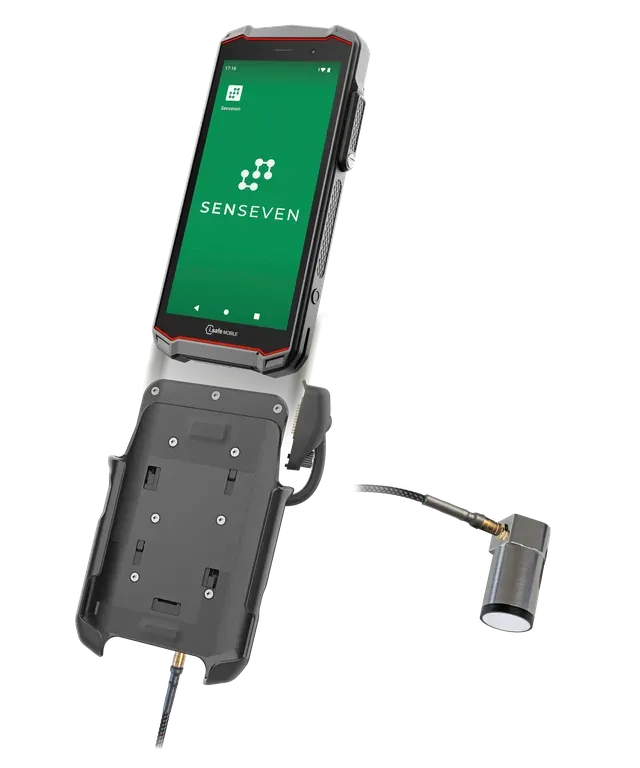
Identify the trap
Scan its tag, or enter its details in the app: trap type, system pressure, steam temperature.
-
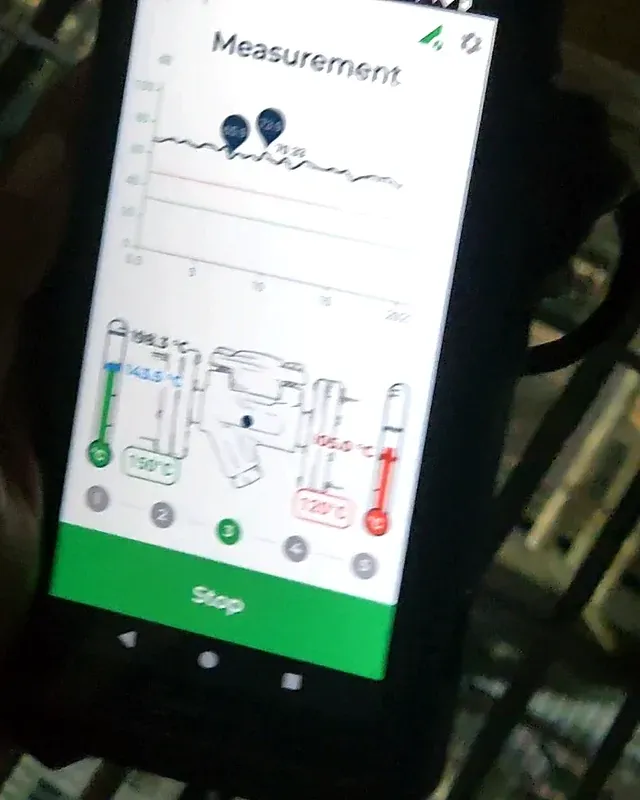
Measure sound and temperature
The app takes you point by point: the temperature before and after the trap, the sound before, on and after it.
-
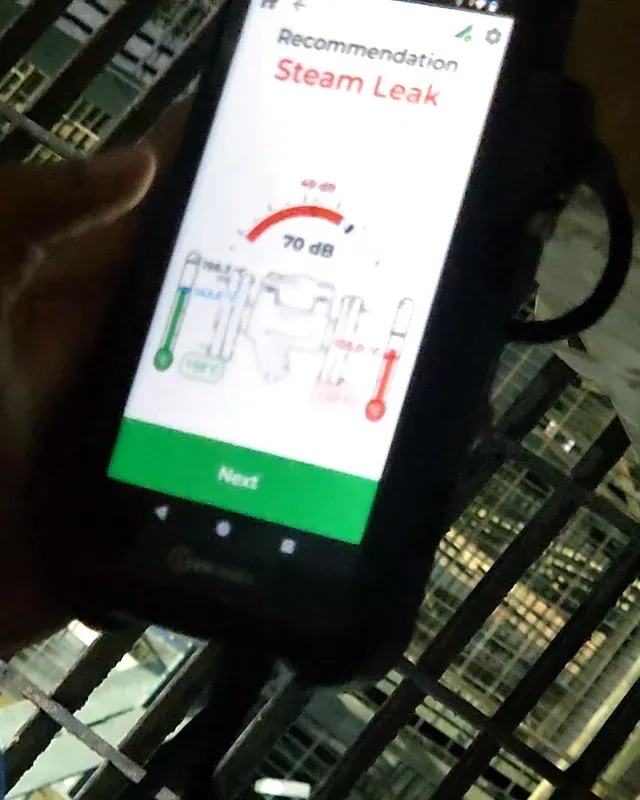
Get the result on site
Functional, leaking, blocked or condensate overflow, within seconds.
-
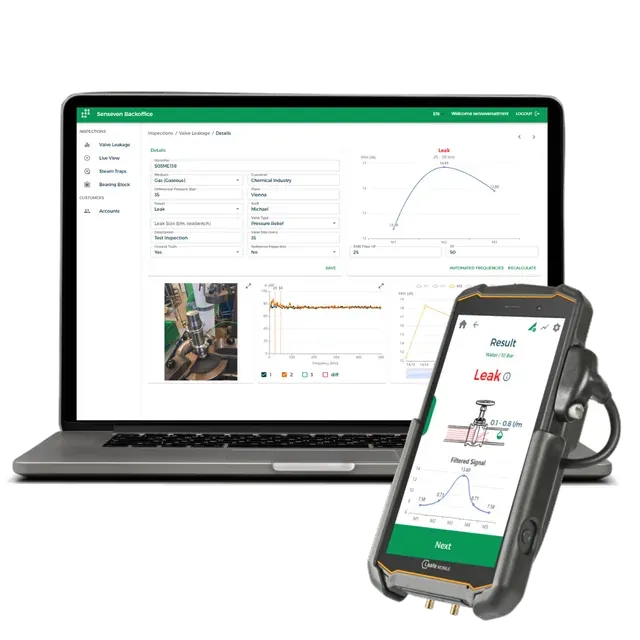
Create the report instantly
Turn Senseven's report into maintenance actions and plans: the leaking traps first.
From the i-Kcal Thermal Academy — here is the physics, if you want it. What a survey actually finds, and how traps fail: Steam traps and Trap surveys and management in our free academy.
Where it is used
See it in your industry
FAQ
Trap Sense and Valve Sense questions
What is included in the Trap Sense and Valve Sense package?
A complete package of hardware and software, shipped in a hard product shell case: rugged smartphones (Samsung, and i.safe MOBILE for Ex areas), the measuring technology, acoustic emission sensors, a waveguide for hot and cold surfaces, the Senseven app for testing steam traps and finding internal leaks in valves, and access to the Senseven back office for structured storage of all measurement data, automated reporting and further analysis.
What does Trap Sense find in a steam trap?
Whether the trap works, and if not, how it has failed. Trap Sense combines acoustic and temperature measurements and gives one of four results on site, within seconds: functional, leaking (passing live steam), blocked, or condensate overflow. Every result goes to the Senseven back office for the report.
How many traps can be tested in a day?
Each measurement takes seconds; a survey goes at the pace of access, tagging and recording on a running plant. In our October 2026 audit at a chemical plant in India we tested 190 traps in 4 days.
What is needed to test a steam trap?
The trap in service, with steam on it, and access to the trap body and the pipe on either side. The app asks for the trap’s details (type, system pressure, steam temperature) and records the temperatures before and after the trap, read with a surface thermometer, beside the acoustic measurements.
What is acoustic emission testing (AET)?
Acoustic emission testing is a non-destructive test technique that detects high-frequency stress waves emitted by changes in materials or structures under load. These waves can also be detected on structures or components where a leak flow, caused by a pressure difference, generates acoustic emission. It allows a discontinuity and its progress to be detected, even before the defect or fault occurs.
Which smartphones are used?
For industrial applications the delivery includes the robust Samsung Galaxy XCover Pro. For international Ex zones we use the 5G smartphone IS 540.1 from i.safe MOBILE. Both phones have the power to process the amount of data, and the measuring systems are adapted to the smartphones.
Which valves can be inspected?
All on/off, control and safety valves of any size. For larger valves (above DN 100), several measurements must be taken on the valve body and small leaks may be harder to find.
What is needed before testing a valve?
The valve must be closed, there must be a pressure differential of at least 1 bar across it, and insulation must be removed or access to the pipe granted. Before starting the measurement, the medium must be selected; additional information is optional.
Does the valve material matter?
Grey cast iron or glass valves make it difficult to detect small leaks. Otherwise, the system can be used for any material.
Which media does it work with?
The system is optimised for water, gas, steam and pressurised air. It also works for other media such as viscous liquids, but the smallest detectable leak size can be larger than for other media.
Can it be used at high pressure?
Yes. High pressure is even an advantage: the higher the pressure, the stronger the acoustic emission signal created by the leak. A minimum pressure differential of 1 bar is required to detect acoustic emission signals.
What is the smallest detectable leak?
It depends on valve type and size, pressure differential, medium, valve material and industrial noise. As an example, for gas at 3 bar on a DN25 valve, you can expect a detectable leak rate of 50–100 millilitres per minute. High pressure supports the detection of smaller leaks.
Can Valve Sense estimate the leak rate?
Yes. Valve Sense already has a first version of a leak-rate model, now being tried by its first customers. It gives an estimated range, e.g. 0.3–0.8 litres/minute, to help prioritise maintenance work on valves.
Can I view the results on other devices?
The measurement software runs on the smartphones, but the Senseven back office gives you access to all measurements from any device for reporting and analysis.
Is training included?
Yes. After purchasing the product you will receive an introduction to its operation, and we are happy to issue a certificate of participation.
Certification
Certificates
See it in action
Check out the desktop demo version
Tell us a little about your plant, and Senseven’s click-through desktop demo opens in a new tab.