We put the flash steam from your condensate back into the process, keep the spray-dryer air heater at temperature with less need for the bypass, and make hot water from steam with less of it. Sized on your own meter readings.
steam recovered instead of vented, food & beverage plant in Spain
up to 15%
more heating output from the air heater you already own
10–15%
less steam than a plate exchanger, for hot water
Baelz figures: a food & beverage reference in Spain, recirculation and the hot-water generator. Not a dairy result: yours comes from your own readings. Read the food & beverage case
Behind every Jetomat
Jetomat® variable-nozzle thermocompressors, made in Germany by Baelz. Engineered and commissioned in India by i-Kcal.
20,000+
Baelz thermocompressors globally
28+
years of fail-safe operation in India
This season · Flush seasonMilk intake peaks, and evaporators and spray dryers run at full load. Recovered vapour and flash steam pay back fastest in these months.Talk to an engineer
This season · MonsoonWet biomass and coal burn less efficiently, so every tonne of steam costs more fuel in these months. Steam recovered from flash and condensate is worth the most now.Talk to an engineer
Where it leaks
Where your steam money goes
Six things a dairy utility head knows too well.
“The air heater won’t hold temperature unless someone cracks the bypass.”
Condensate builds up in the heater tubes, the hot air for the dryer drifts, and the bypass opens. Live steam goes straight to loss.
“Flash steam goes up the vent.”
Hot condensate flashes as its pressure drops: from 8 bar g to atmosphere, about 10–15% of it turns to steam. If nothing uses it, that is fuel you already paid for.
“Powder output is capped by the heater, not the dryer.”
Slower heat transfer in the air heater means longer drying and a ceiling on the day’s production.
“Traps, bypass lines and manual tweaking.”
More parts to fail, more water hammer, and more shifts spent chasing the temperature by hand.
“Hot water for CIP and washdown burns a lot of steam.”
Washing, process make-up water, CIP: across Indian industry, half of what steam does in the end is make hot water.
“Nobody can tell me what the dryer’s steam costs.”
Steam per litre of milk swings with the product mix, powder against liquid. Without a meter on the dryer duty, nobody sees what the heater costs.
What changes
What changes with i-Kcal
Each duty gets the fix that fits it, and every saving is counted on a meter.
Hot air that holds, with less need for the bypass
The Jetomat recirculates steam and condensate through the heater zones with a flash vessel. Faster steam through the tubes clears the condensate film, so the hot-air temperature holds.
A steam-based hot water generator gives hot water the moment it is called for. The indirect Baelz unit uses 10–15% less steam than a plate-exchanger set.
Fewer traps and automatic pressure control on the Jetomat. Trap Sense finds the failed steam traps, and Valve Sense the leaking valves, while the line runs, with a smartphone and an acoustic sensor.
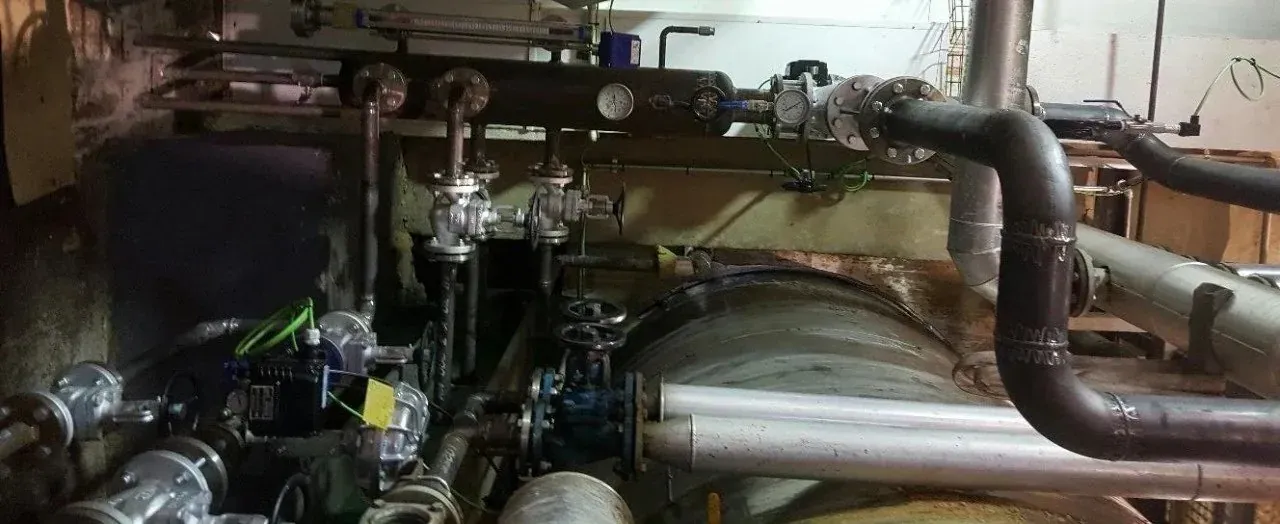
A food & beverage producer in Spain was venting steam through an oversized ejector whose suction-side safety valve stood open. A right-sized Baelz ejector in compression stopped the venting and turned the loss into steam for its heating systems. The same physics as a dairy’s flash steam.
A summary of our industry note for dairy plants: where the spray-dryer air heater loses steam, how one Jetomat per heater bank keeps every coil drained, and what we need from you to size it.
Read Full Dairy Industry Note
Where the steam goes
In a milk-powder dairy, the spray dryer’s air heater is the larger steam user beside the evaporator. A bank of steam coils heats the drying air zone by zone, with a trap at every zone.
In most heaters, steam enters the hottest zone, and each zone’s condensate, through its trap, becomes the next zone’s steam. The heater is set for its worst zone, not for the air.
Where the air heater loses steam
Coils that flood at part load: as the temperature valve closes, the coil pressure falls, the trap has nothing to push against and the tubes fill with water.
A cascade that backs up: every zone’s condensate is the next zone’s back-pressure.
A bypass cracked to hold the hot air, and traps that pass: live steam goes straight through, all shift.
Hot condensate sent to an open tank, where its flash goes up the vent.
One Jetomat loop per air-heater bank
The hot zones become one pressure group, fed by a variable-nozzle Jetomat at one setpoint. Every tube drains without a trap, steam and condensate together, into one separator.
The separator’s steam is the Jetomat’s suction, so it goes round the coils again. Its condensate flashes in a small vessel, and that flash heats the coolest zone. Only the condensate goes back to the boiler house.
Recirculated steam is not saved steam: it keeps the coils drained. The saving is what the heater loses today, past the traps, through the bypass and at the open tank. Each loop is sized with a pressure margin between the steam header and the coils, the energy the Jetomat uses to sweep the tubes.
Before
After · one Jetomat per heater bank
Live and flash steam
From the coils, back to the Jetomat
Condensate
Before: steam enters the hottest zone only, each zone drains through a trap into the next, the low zones flood at part load, a bypass passes live steam and the flash vents at an open tank. After: one Jetomat feeds the hot zones together, their steam goes round again, the flash heats the coolest zone, and only the condensate goes home.
How the loop is controlled
The hot-air temperature sets the coil pressure, and the coil pressure sets the Jetomat’s nozzle, so the air holds its temperature from the flush season to the lean one.
Every steam valve to the heater fails closed: a power failure stops the main fan, and a heater with no air flowing needs no steam. Every drain still works, and the old reducing station stays as the back-up.
Beside the dryer
The open condensate tank is closed, and a variable-nozzle Jetomat sends its flash into the deaerator.
Condensate can carry milk from a leaking pasteuriser plate or evaporator tube, so a contamination monitor on every product-side return goes in first and sends a bad batch to drain.
A pasteuriser or CIP hot-water heater that hunts at part load takes a Jetomat as its control valve and its drain: a steady temperature, no water hammer.
The evaporator’s thermocompressor stays the evaporator maker’s; the Jetomat works beside it, on the preheaters and the live-steam condensate.
On a meter, and what we need from you
A steam meter on the Jetomat’s motive line goes in before anything on the heater changes, and stays: it is the baseline and the proof, in heater steam per kg of powder, shift by shift.
The same Jetomat is proven in food & beverage, as Baelz references: a food factory’s condensate tank, open for 50 years, now sends its steam to the deaerator, and a disc dryer in Spain gained 18% output and one extra batch a day in recirculation. In India, i-Kcal has engineered this scheme for a dairy air heater in Maharashtra.
To size a loop we need one heater: its zones and pressures, the steam to it, the powder it makes, where its condensate goes, the seasons and hours, and your steam cost.
Savings estimator
Estimate your steam saving
Pick a duty and enter your own steam figures. The calculation applies only published figures, each with its owner, to your numbers.
Send your readings to our engineers
Your numbers go into the form below. Our engineers check them against your duty and come back with a range for your plant before you commit.
We reply with a range for your plant, from your own readings.
FAQ
Dairy industry questions
01Can a Jetomat run on a spray-dryer air heater?
Yes. The Jetomat recirculates steam and condensate through the heater zones with a flash vessel, which holds the hot-air temperature steady with less need for the bypass. i-Kcal has engineered this scheme for a dairy air heater in Maharashtra.
02How much steam will we save?
It depends on how much steam your duty vents or loses through the bypass. Baelz quotes 10–30% direct saving where low-pressure or flash steam is recompressed, and up to 15% more heater output with recirculation. We give you a range from your own readings before you commit.
03Does it replace the bypass valve and the traps?
It cuts the need to open the bypass: faster steam through the tubes and active condensate removal keep the heater working, and recovered flash is reused, not vented. In textile references the drum traps came off altogether.
04Does the steam touch the milk or the powder?
No. In an air heater the steam stays inside the coil bank and heats the air through the tube wall. The Jetomat works on the steam and condensate side only.
05What is the payback?
Typically 6–18 months, depending on the application and the fuel price. A food & beverage plant in Spain recovered 1,240 kg/h once its ejector was right-sized. We do not quote prices on the website: your figure comes from your readings. Estimate your saving.
Know what your dryer steam costs
Estimate your saving from your own steam figures, then send them to our engineers. We size it on your meter readings.