
Near-zero boiler blowdown losses with flash and heat recovery
American blowdown control meets German flash-steam recovery. Blow down only when TDS says so, and recover the heat from what you do discharge.
- 1–3%Higher boiler efficiency (TDS control plus heat recovery)
The system
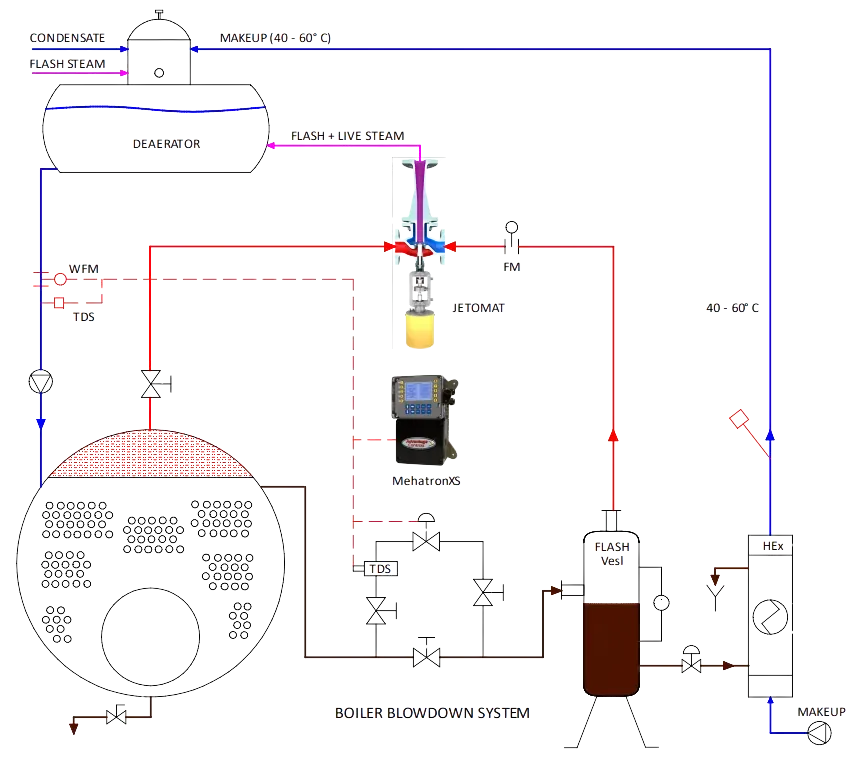
The blowdown system, labelled
Blow down only when TDS says so, and recover the heat from what you do discharge.
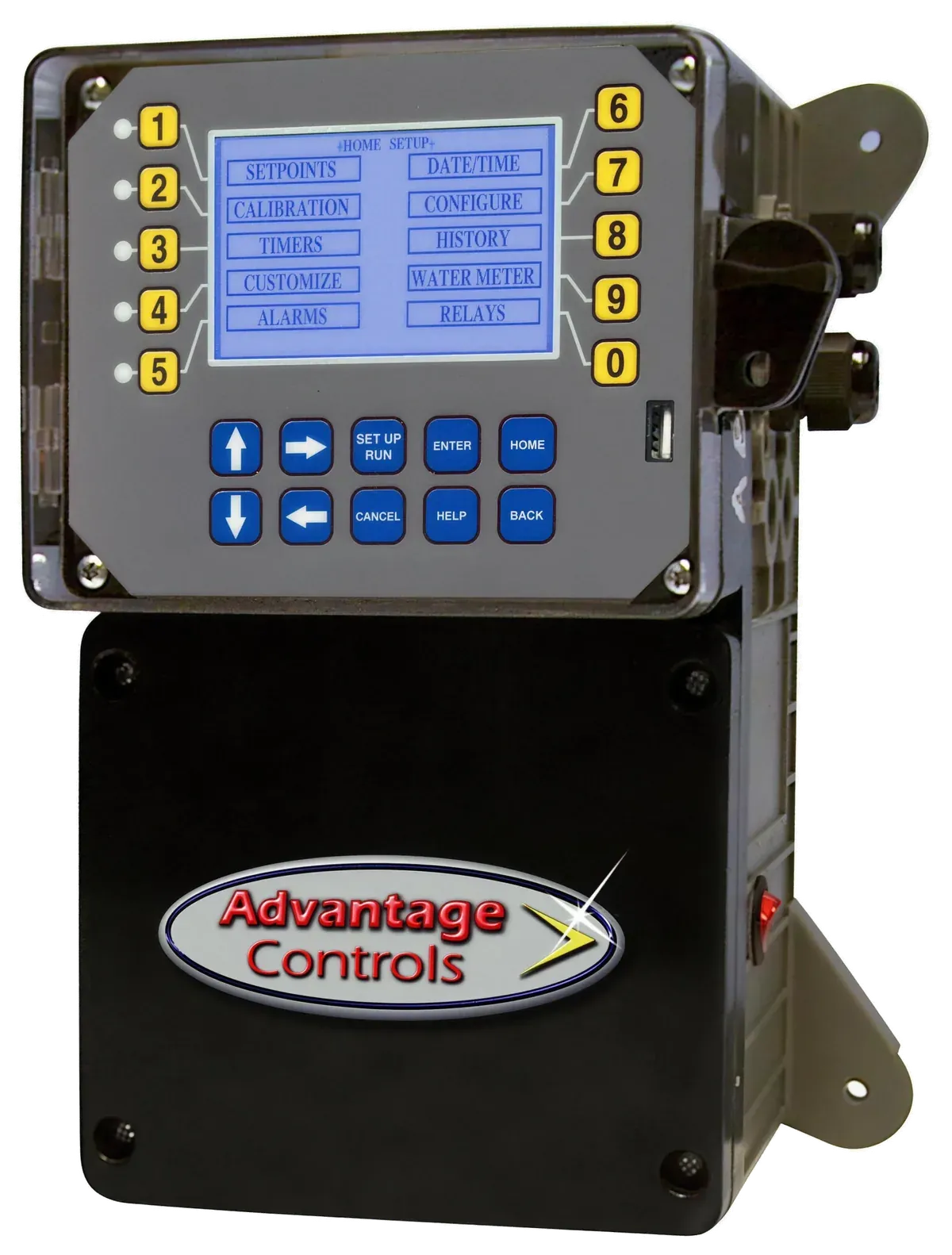
- Controller Conductivity data is analysed continuously against the preset TDS value. Excess levels trigger corrective action.
- TDS sensor Highly sensitive, temperature-compensated TDS sensors monitor the conductivity of the boiler-water blowdown sample.
- Blowdown valve When TDS exceeds the setpoint, the system automatically opens the blowdown valve to discharge high-TDS water from the boiler.
- Heat recovery Less fuel is spent heating cold make-up water, and flash and heat recovery nearly eliminate blowdown costs.
Manual vs automatic
Why use a blowdown system with heat recovery?
Boilers need regular blowdown to remove impurities such as dissolved solids that build up during operation. Without effective blowdown management, they cause scaling, corrosion and lost efficiency.
-
Manual blowdown is not linked to steam load or feedwater quality, so average TDS often ends up much lower than the set limit — wasting water and energy.
-
An automatic boiler blowdown system (BBS) blows down only on TDS measurement and holds TDS close to the allowed limit.
How it works
How the BBS works
This cycle of monitoring, blowdown and stabilisation repeats automatically.
-
Continuous TDS monitoring
Temperature-compensated sensors measure the conductivity of the boiler water.
-
Signal processing
The controller compares the reading with the TDS setpoint.
-
Blowdown activation
Above the setpoint, the blowdown valve opens and high-TDS water leaves the boiler.
-
TDS stabilisation
Fresh feedwater comes in and dilutes the remaining dissolved solids.
-
Recheck and close
TDS is watched throughout, so only the water actually needed is blown down.
-
Heat recovery
Flash steam and heat recovery nearly eliminate the cost of blowdown.
Illustration, traced from our schematic.
Here is the physics, if you want it.
How TDS sets your blowdown rate, and what it costs to get it wrong: Blowdown and TDS control in our free i-Kcal Thermal Academy.
Benefits
Benefits of automatic blowdown with heat recovery
| Item | Benefit | Description |
|---|---|---|
| 01 | Enhanced energy efficiency | Boiler efficiency rises by 1–3%. Less fuel is spent heating cold make-up water, and flash and heat recovery nearly eliminate blowdown costs. |
| 02 | Water conservation | Lowers make-up water and chemical dosing by cutting out excess blowdown. |
| 03 | Extended boiler life | Avoids scaling and corrosion by keeping water TDS within guidelines — fewer repairs, longer boiler life and safer operation. |
| 04 | Automation and precision | Continuously monitors TDS and other parameters in real time, reducing operator workload and errors and enabling precise blowdown. |
| 05 | Improved steam quality | Prevents foaming and water carryover by holding boiler TDS at the optimum, minimising scaling in process equipment, steam pipes and valves. |
Key features
Controller and system features
- Versatile sampling methods
- Automatic blowdown control
- User-friendly and flexible
- Error correction
- Up to 20 assignable relays (MegaTron MT controller)
- Multilevel security
- Chemical dosing control
- Water flow meter input
- Modbus, Wi-Fi and internet cards
Where it is used
See it in your industry
FAQ
Boiler blowdown questions
Is the automatic boiler blowdown valve part of the system?
Yes. The TDS sensor and the automatic blowdown valve sit on the boiler. When TDS rises above the setpoint the controller opens the valve, and it adjusts the valve during blowdown, so only the water that has to go is discharged.
Why do boilers need blowdown?
Dissolved solids and other impurities accumulate in boiler water during operation. Without effective blowdown management they lead to scaling, corrosion and reduced efficiency.
What is wrong with manual blowdown?
Manual blowdown is not linked to steam load or feedwater quality, so average TDS often ends up much lower than the set limit — meaning excessive water and energy loss.
How does an automatic blowdown system work?
Temperature-compensated TDS sensors monitor boiler-water conductivity continuously. When TDS exceeds the setpoint the blowdown valve opens automatically, and it is adjusted during blowdown so only the needed quantity of water is discharged. The cycle of monitoring, blowdown and stabilisation repeats automatically.
How much can automatic blowdown save?
1–3% higher boiler efficiency: less blowdown under TDS control, plus heat recovered from what is blown down (the gain depends on today’s blowdown rate). With flash and heat recovery, blowdown costs are nearly eliminated, and make-up water and chemical dosing fall because excess blowdown is avoided.
Can the controller connect to plant systems?
Yes. It has up to 20 assignable relays (MegaTron MT controller), water flow meter input, chemical dosing control and Modbus, Wi-Fi and internet cards.
How much are you losing to blowdown?
Share your boiler capacity, feedwater quality and current blowdown practice. We will estimate the water, fuel and chemical savings of automatic TDS control — free.