Condensate Pump: Electric or Steam-Powered, and Net the Motive Steam
A steam-powered condensate pump never cavitates, but it runs on steam. When it beats an electric pump, when it does not, and how to take its motive steam off the saving.
On this page
Hot condensate is awkward to pump. An electric pump on condensate near boiling point cavitates, so plants cool it first and throw away the heat they meant to save. A steam-powered pump solves that, but it runs on steam, and many proposals forget to take that steam off the saving.
This post is about making the choice honestly: which pump suits which duty, and how to work out what each one really saves.
Why hot condensate defeats an electric pump
A centrifugal pump needs a cushion of pressure at its suction above the water’s own vapour pressure. Lose it and the water boils in the impeller eye. That is cavitation.
The steam tables show how thin the cushion gets. Condensate at 70 °C has a vapour pressure of 0.31 bar a. An open receiver at 1.01 bar a gives it about 7 m of margin before the tank height is even counted. At 95 °C the vapour pressure is 0.85 bar a, and the margin from the atmosphere falls to under 2 m. The rest has to come from standing the receiver higher above the pump.
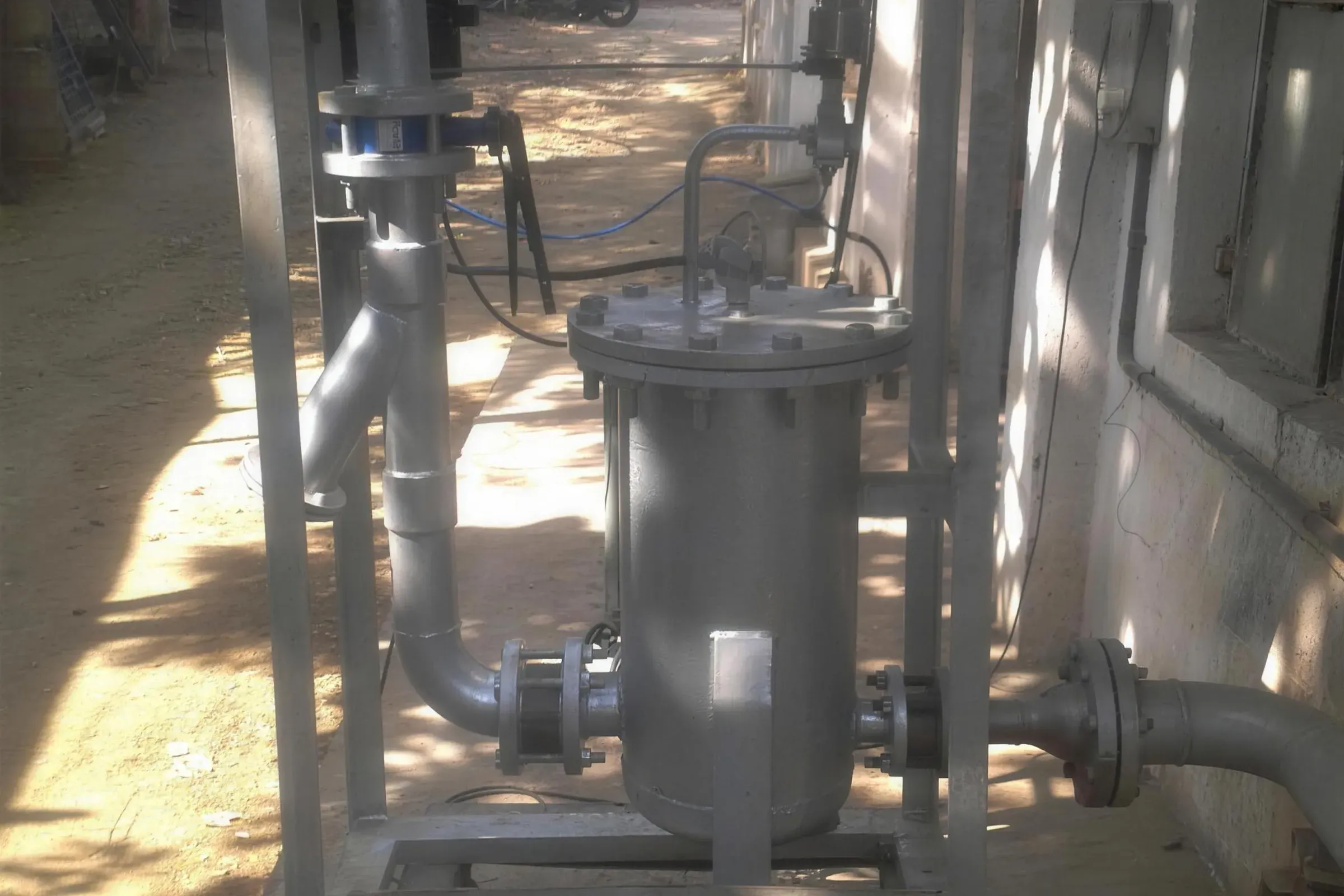
A steam-powered (pressure-powered) pump works differently. Condensate fills a vessel by gravity; at the trip level, motive steam pushes the charge out through a check valve. Nothing spins, so there is nothing to cavitate, and there is no motor.
Where the steam pump clearly wins: when the electric pump forces cooling
In one walk-through audit, electric pumps on 90–95 °C condensate cavitated, so the condensate was cooled in the collection tank before it was pumped. The note behind it puts the cooling at about 20 K (an assumption), which is 20 kcal lost on every kilogram, plus a 5 kW pump running.
A steam-powered pump at about 3 kg of motive steam per tonne uses roughly 2 kcal per kilogram pumped, even if its exhaust is lost (3 kg × about 660 kcal/kg, spread over 1,000 kg). It gives back about ten times what it costs in steam. That is an easy decision.
Where it may not: when the electric pump already works
In another survey, electric pumps of 3.7 kW and 2.2 kW were already returning about 90 % of the condensate at about 90 °C. The proposal replaced them with a steam-powered pump and credited 7.5 kcal/kg on 6,000 kg/h: 45,000 kcal/h.
The review found three problems:
- The credit assumed condensate at 105 °C. In a vented tank it flashes down to 100 °C, so the gain the credit rests on was never established.
- The flow actually returned was about 5,450 kg/h, not 6,000.
- At 2–3 kg per tonne, the pump would use 11–16 kg/h of motive steam. If vented, that is about 7,000–11,000 kcal/h, a large slice of the 45,000 claimed. The proposal never deducted it.
What is left is mainly the electricity: about 85 kWh a day on the review’s run-time figure. That may still be worth having, but it is a power saving set against a steam cost, and it should be priced as one.
Netting the motive steam
Write the saving in three lines:
- Heat regained: condensate kg/h × the degrees it arrives hotter than today, in kcal/h.
- Power saved: the electric pump’s measured kW × hours, at your tariff. One kWh is 860 kcal, but a kWh costs more than a kcal of fuel, so price it separately.
- Minus motive steam: about 3 kg per tonne pumped as a first estimate (one job worked out 8.4 kg/h for 2,800 kg/h, another quoted 2.5–3 kg per tonne). If the exhaust vents, count it at its full heat, about 660 kcal per kg.
The motive figure rises with back pressure, so replace the estimate with the maker’s figure at your duty. Where the exhaust goes to a closed receiver or a recovered flash system, much of its heat comes back.
Write the back-pressure budget first
A steam-powered pump only works if its motive pressure beats everything the condensate has to push against: the static lift (about 1 bar for every 10 m), the friction in the line, and the pressure at the receiving end. One worked selection had 10–15 m of lift, a 450 m run and 2.5 bar g of total back pressure against 3.5–4.0 bar g of motive, and set three checks: motive at least about 1 bar above back pressure, the static head inside the back-pressure figure, and a rating about 1.5 times the computed load. Capacity falls as back pressure approaches motive pressure, so read it off the maker’s curve at your real figures.
Which pump, where
An electric pump suits:
- condensate well below boiling, around 70 °C or cooler, where suction margin is not a worry;
- a receiver that can stand high enough above the pump;
- steady, large flows over a long run, with reliable power.
A steam-powered pump suits:
- condensate near boiling that an electric pump would make you cool;
- drains with no power nearby;
- hazardous areas, since it needs no motor (one chemical-site skid specified all its instruments intrinsically safe);
- modulating users that stall, where a pumping trap drains what the steam pressure cannot.
Watch the receiver vent
Either pump usually sits under a vented receiver, and the vent is where flash and motive exhaust leave. At a chemical plant in Bharuch, condensate went to the power plant by a pressure-powered pump package and its flash vented to atmosphere, until a variable-nozzle Jetomat put 422 kg/h of it back into the 3.5 bar header. A food factory closed a condensate tank that had stood open for 50 years and sent its steam to the deaerator. To price your own plume first, see what a condensate tank’s flash costs. The lesson on stall and condensate pumping covers the suction arithmetic in full.
What we need from you
- Condensate flow, peak and average, and its temperature at the receiver.
- Lift and length of the run to the feed tank, and the pressure at the receiving end.
- The motive steam pressure available near the pump.
- Whether the area is hazardous and whether power is at hand.
- Your steam cost and power tariff.
FAQ
How much steam does a steam-powered condensate pump use?
About 3 kg of motive steam per tonne of condensate pumped is a fair first estimate. It rises with back pressure, so take the real figure from the maker's curve at your lift, line and receiving pressure.
Is a steam-powered pump always the better choice for hot condensate?
Not always. It wins where an electric pump would cavitate or force you to cool the condensate. Where an electric pump already returns the condensate hot, the gain may be little more than the electricity, and the motive steam eats into that.
What motive pressure does it need?
More than the total back pressure: static lift (about 1 bar for every 10 m), line friction and the pressure at the receiving end, with about 1 bar to spare.