One Kilogram Through a Tyre Plant: Press, Bladder, Mould, Condensate
Follow one kilogram of steam through a tyre curing press, from the platen and bladder to the condensate tank, and see why the press bank, not the press, is where to recover it.
On this page
A tyre plant’s steam bill is decided at the curing presses. Follow one kilogram of steam through a press and you find out where it does its work, where it is lost, and why recovery belongs on a row of presses, not on one.
In a typical plant the curing presses take about four-fifths of the steam, and about three-fifths of the cure heat goes into the moulds. So a kilogram of steam in a tyre plant is, most of the time, a kilogram on its way to a mould.
The cycle a kilogram has to fit into
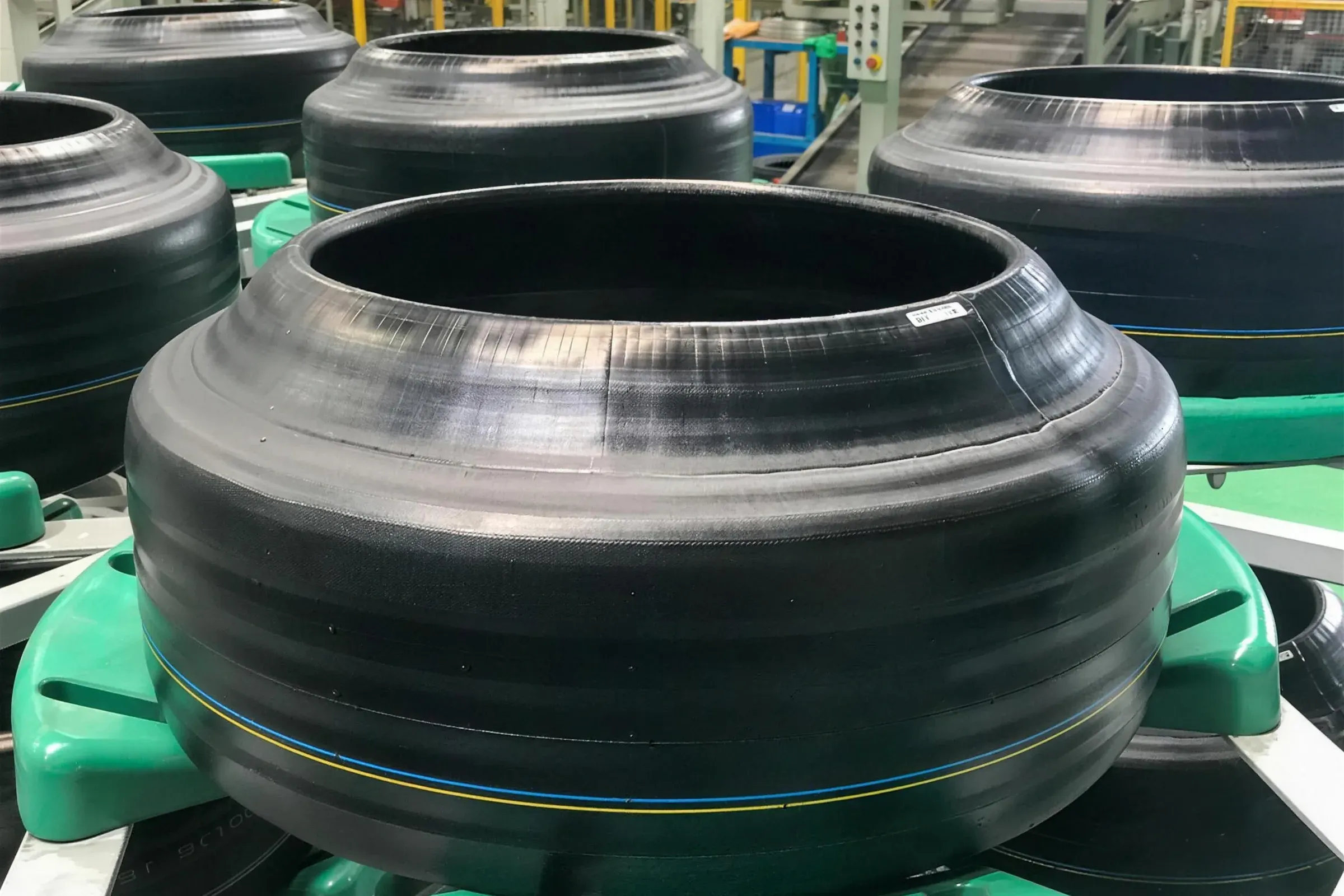
Every press repeats the same cycle: load, shape, cure hold, blowdown, vacuum, open. A car tyre cures in about 10 to 15 minutes, a truck tyre in 40 to 90. The steam has two jobs in that cycle, on two sides of the green tyre.
The mould side: steady heat, slow condensate
The platens, or the dome around the mould, stay on steam while the press cures, typically at 4 to 8 bar g (150 to 175 °C) on platen and container presses and 4 to 6 bar g on domes. A twin car-tyre press condenses about 60 to 120 kg of steam an hour on the mould side.
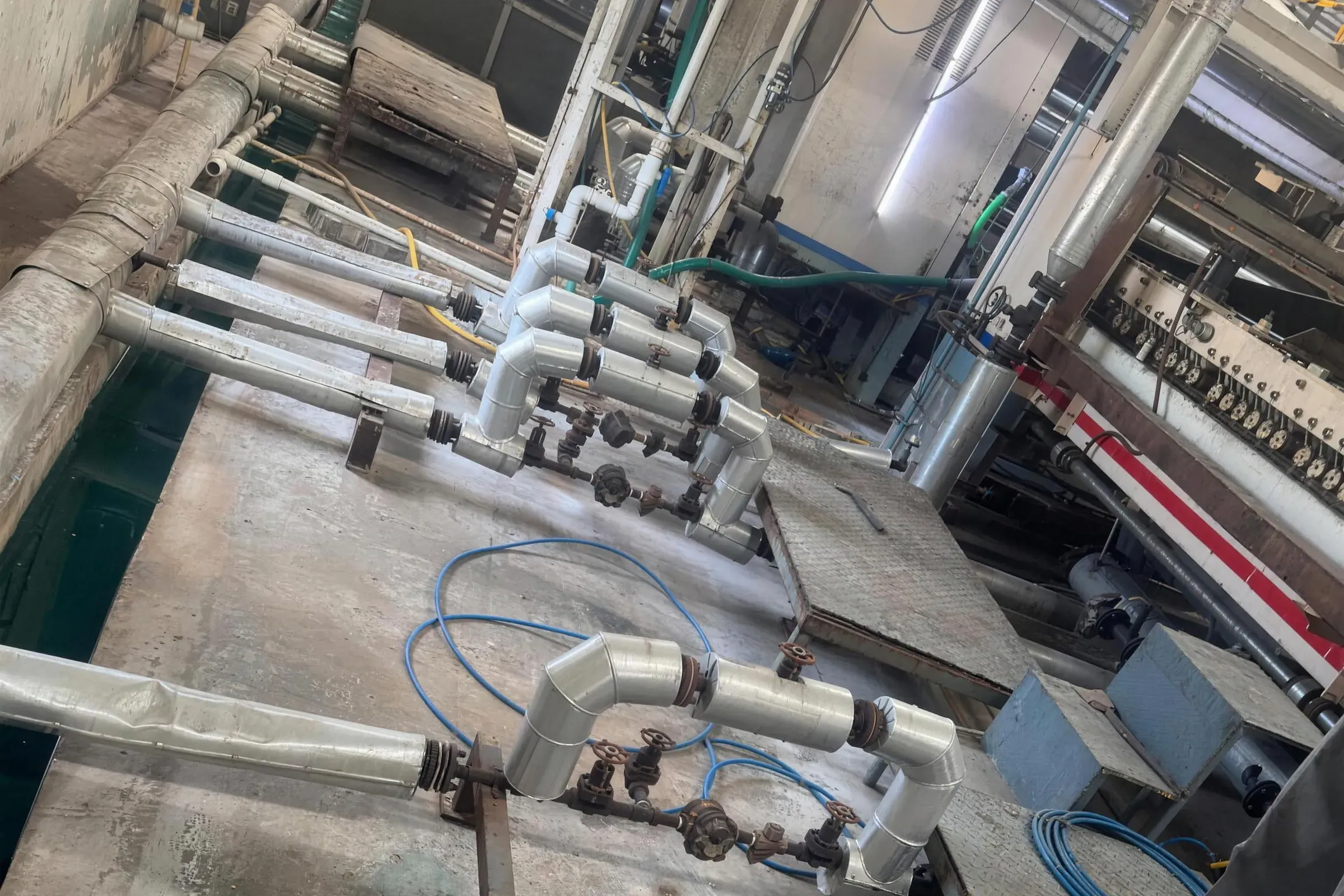
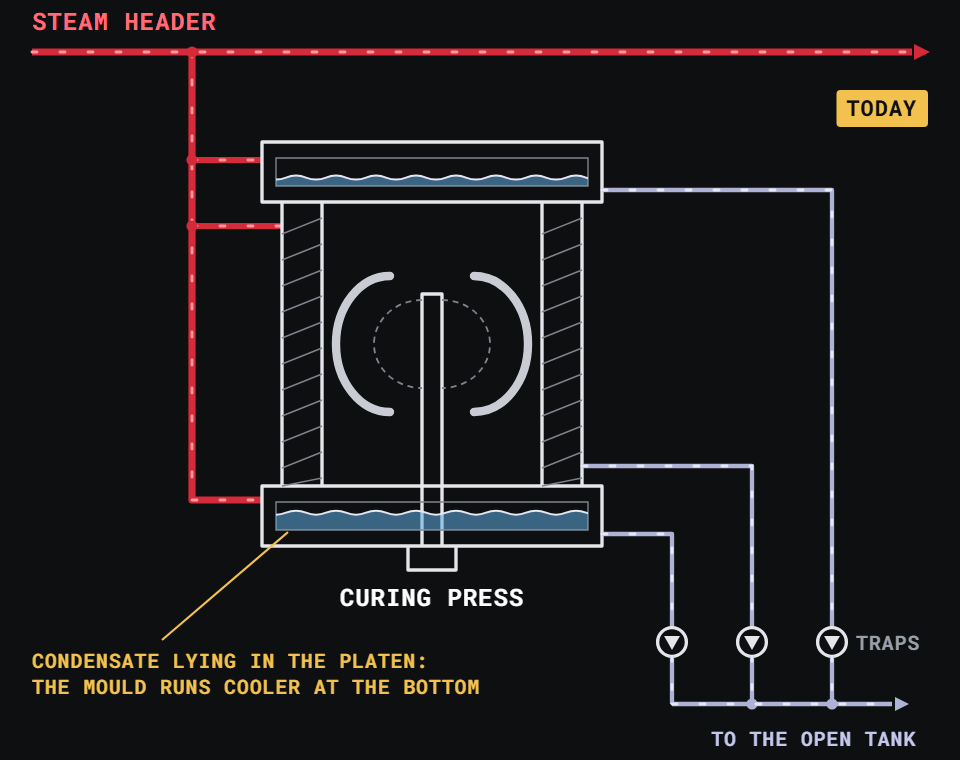
That condensate is where the trouble starts. On a trapped press it lies in the platen until the trap opens, so the mould runs cooler at the bottom and the cure runs to its slowest spot. Operators answer with a cracked bypass, and live steam goes to drain with the water.
The bladder side: hot, short and small
Inside the tyre, the bladder shapes it at 0.3 to 1.4 bar g, then holds the cure at 14 to 21 bar g (198 to 217 °C). At the end it blows down to a manifold in 20 to 60 seconds, and a vacuum pulls it in. A steam-cured bladder condenses about 3 to 8 kg of steam per car-tyre cure, and the vapour left at blowdown is only 0.2 to 0.4 kg.
That is the first surprise for most plants: the bladder looks like the big loss, with its noise and its burst of vapour, but the steady stream is on the mould side.
Where the kilogram ends up
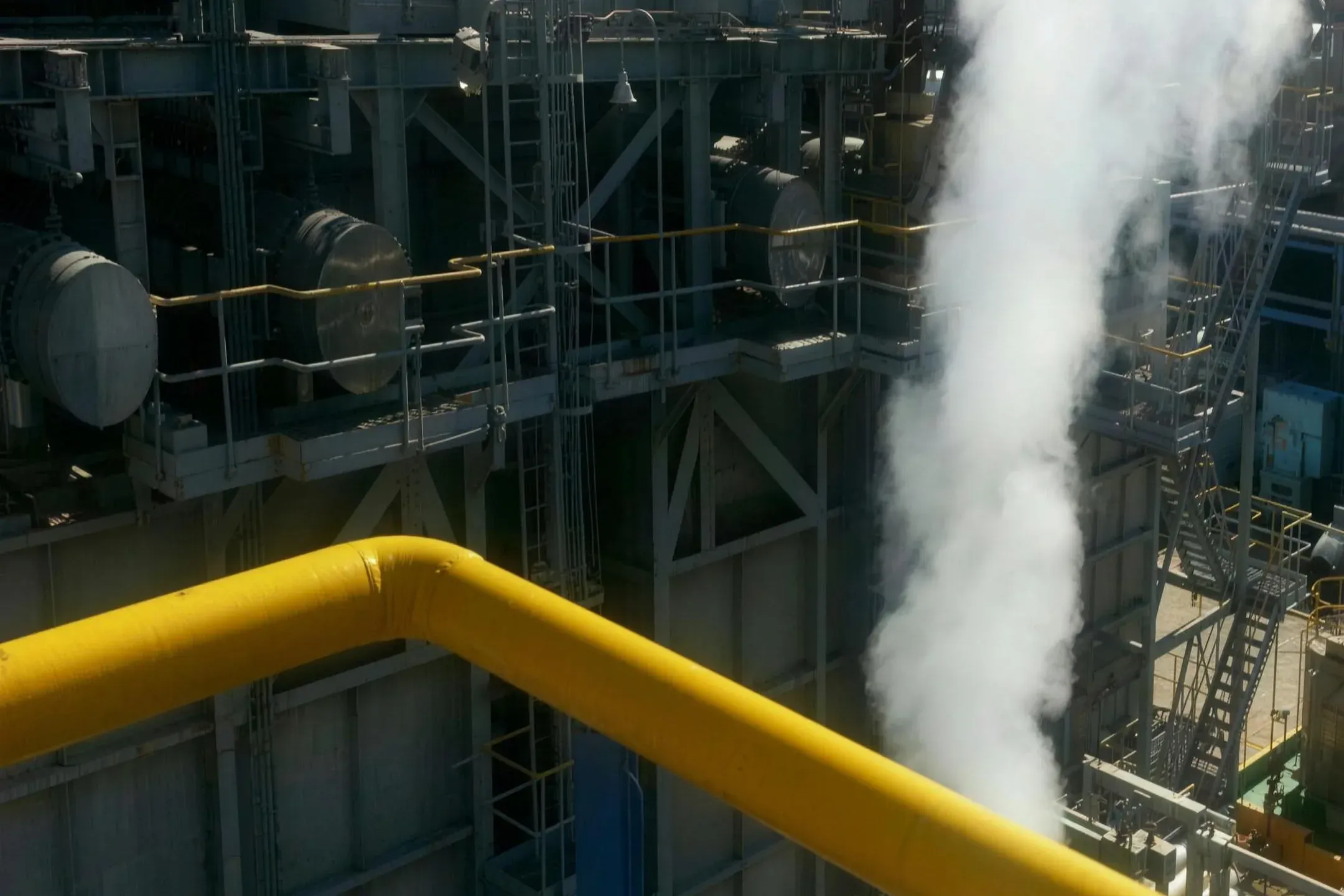
On a conventional press, the mould condensate passes a trap and reaches an open tank. From 7 bar g, about 13 % of it flashes to air there, and the plume over the hall is that flash. Add the steam that passes worn traps and open bypasses, and the Monday warm-up of four to six tonnes of steel per press, and you have the whole loss list. None of it is exotic. All of it is on the mould side.
Why the press bank, not the press
The obvious move is a recovery device on each press. It runs into the cycle: one press goes from full demand to nothing every 10 to 15 minutes, so anything sized for that press spends most of its life far off its design point.
A bank is different. Presses on one setpoint behave as one steam user: their cycles stagger, and the load the bank draws is steady. That steady load suits a variable-nozzle Jetomat®:
- High-pressure steam from the bladder header drives the Jetomat.
- The bank supply feeds every press in parallel.
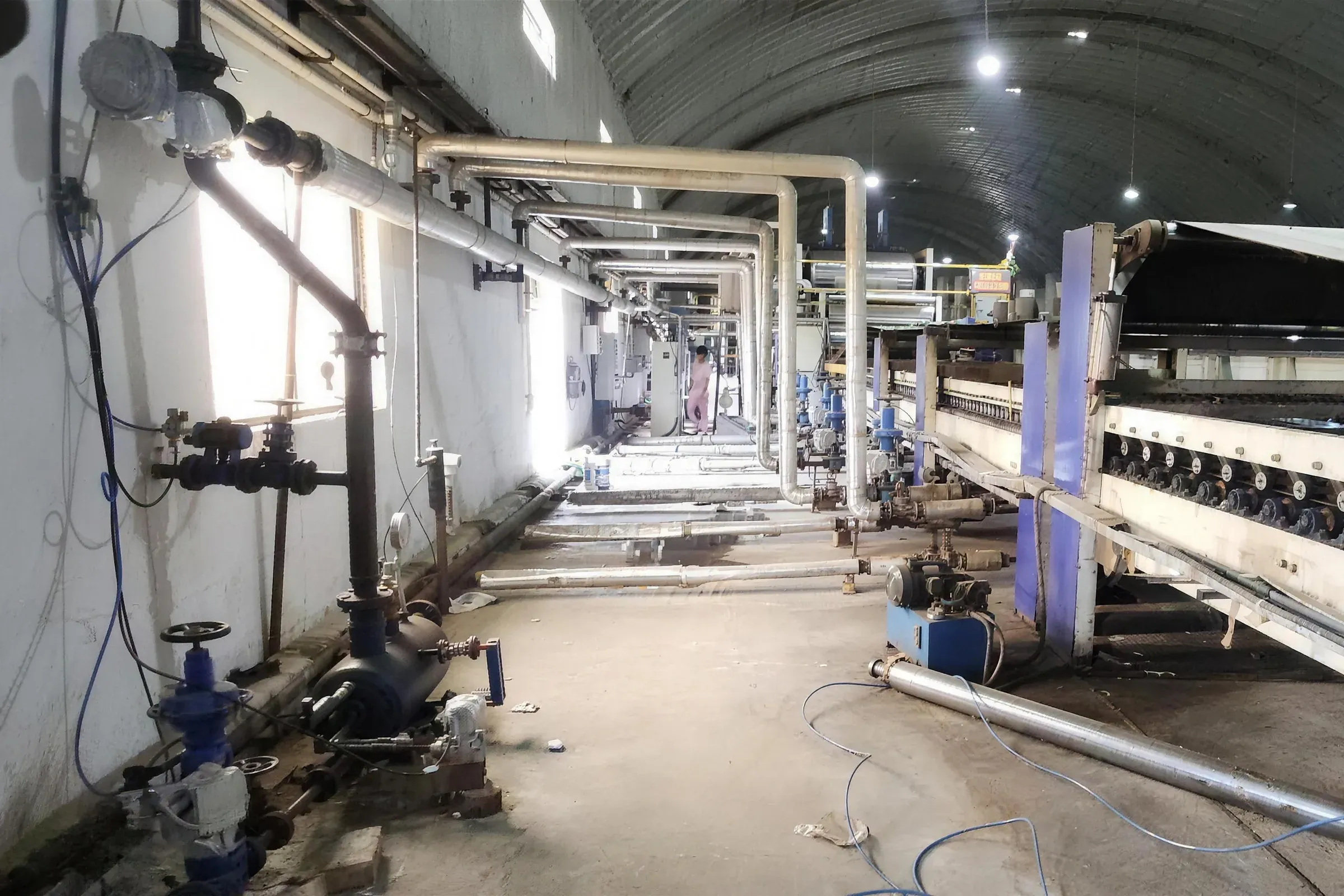
- Each press returns through its own isolation, balancing and non-return valves into one falling return and the bank separator.
- The separator’s vapour is the Jetomat’s suction. Only condensate goes home, hot and closed.
In saturated steam, pressure is mould temperature. The bank holds about ±0.05 bar at 7 bar g, a quarter of a kelvin at every mould. The loop fails closed, with a bypass at the same setpoint, so a fault leaves the presses where they are today. Staggered cycles keep the spindle mid-stroke, and that is the operating point a variable nozzle is built for.
Recirculated is not saved
A bank loop moves a lot of steam round. In a worked bank of twelve car-tyre presses, 960 kg/h of live steam goes in and about 480 kg/h is recirculated. The 480 is not the saving. It buys drainage and even moulds.
The saving is the steam that stops passing traps and bleeds, the flash that stops venting, and the condensate that comes home hot. Measure those.
The same jet works on a press hall’s exhaust steam. At one global tyre maker, the presses’ exhaust steam at 1 bar a went to atmosphere after each curing-press loop. It is now collected in one header, and two Jetomats mix it with 7 bar g motive steam and deliver it at 0.7 bar g to low-pressure heat users. Each unit lifts 611 kg/h of exhaust on 800 kg/h of motive steam, and the plant reuses 15,000 kg of steam a day.
What we need from you
Send us the number of presses per row, car or truck tyres, the platen or dome pressure, the bladder supply pressure, the cure time, and where the mould condensate goes today. That is enough to tell you how the rows split into banks and what each bank is losing.
FAQ
Should each press get its own Jetomat?
Usually not. One press swings from full demand to none in every cycle. A bank of presses on one setpoint staggers its cycles, so the load is steady and one variable-nozzle Jetomat serves it with its spindle mid-stroke.
Our bladders run on nitrogen. Does this still apply?
Yes. Where the bladder runs on nitrogen or hot water, the mould-side bank works the same.
What do you need from us for a first answer?
The number of presses per row, car or truck tyres, the platen or dome pressure, the bladder supply pressure, the cure time, and where the mould condensate goes today.