The Pressure-Reducing Station: Where a Chemical Plant's Flash Steam Disappears
In a chemical plant the steam loss sits where one header pressure becomes the next. How an ejector reduces the pressure and takes back the vented LP steam.
On this page
Expanding a chemical plant usually starts with a question about the boiler. Ask about the pressure-reducing station (PRS) first.
A chemical plant does not have one steam system. It has a header cascade: high pressure raised in the boiler house, stepped down to medium pressure, then stepped down again to low pressure, with a different consumer on every level. Almost everything worth recovering is lost where one pressure becomes the next.
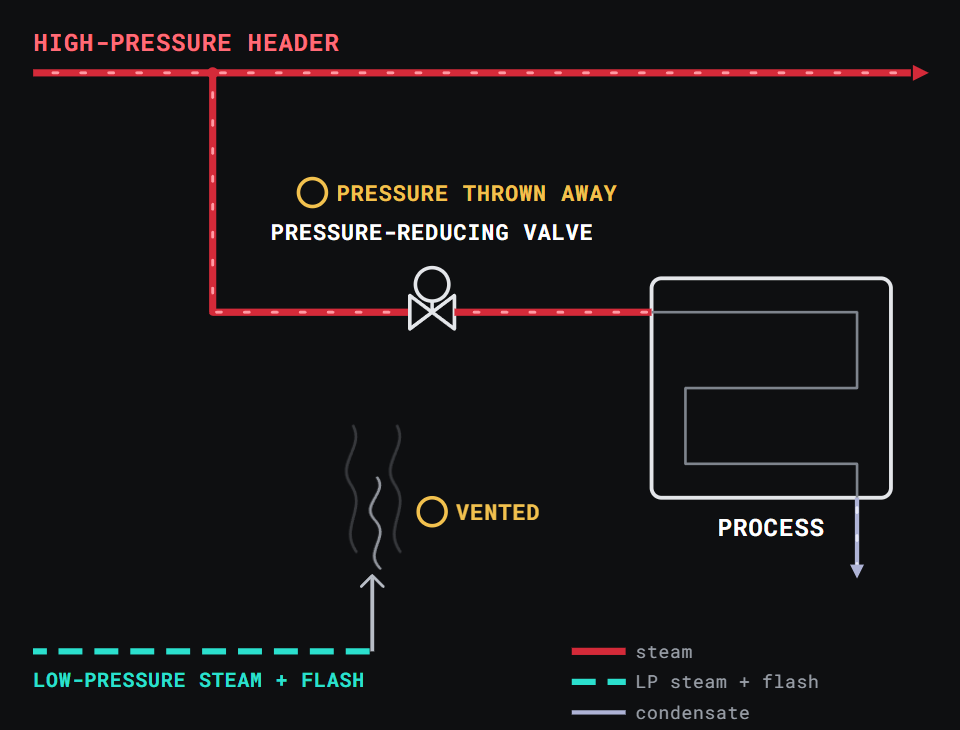
What a pressure-reducing valve actually throws away
A pressure-reducing valve does one job. It drops the pressure. The drop does no work.
Take saturated steam at 13 bar abs. It carries about 666 kcal/kg. Throttle it through a valve to 4 bar abs and it still carries about 666 kcal/kg, because a valve keeps the heat and throws away only the pressure. The steam leaves the valve at about 165 °C, some 20 °C of superheat above the 144 °C a 4 bar abs user expects.
So the heat is not lost at the valve. What is lost is the pressure, and pressure is what could have done work: driving a turbine, or driving a jet that lifts low-pressure steam back up to a usable level.
The second loss, on the same site
The same plant very often has more low-pressure steam than it can use. Flash from condensate drums, exhaust from turbines and surplus from the LP header have nowhere to go, so they leave through a vent.
That gives two losses, back to back and in opposite directions:
- At the PRS, medium-pressure steam is throttled down to feed a low-pressure user.
- At the vent, low-pressure steam leaves because there is more of it than demand.
One is short of steam at 4 bar, the other has too much at 3 bar. A valve cannot connect the two. A jet can.
Reducing the pressure through a nozzle
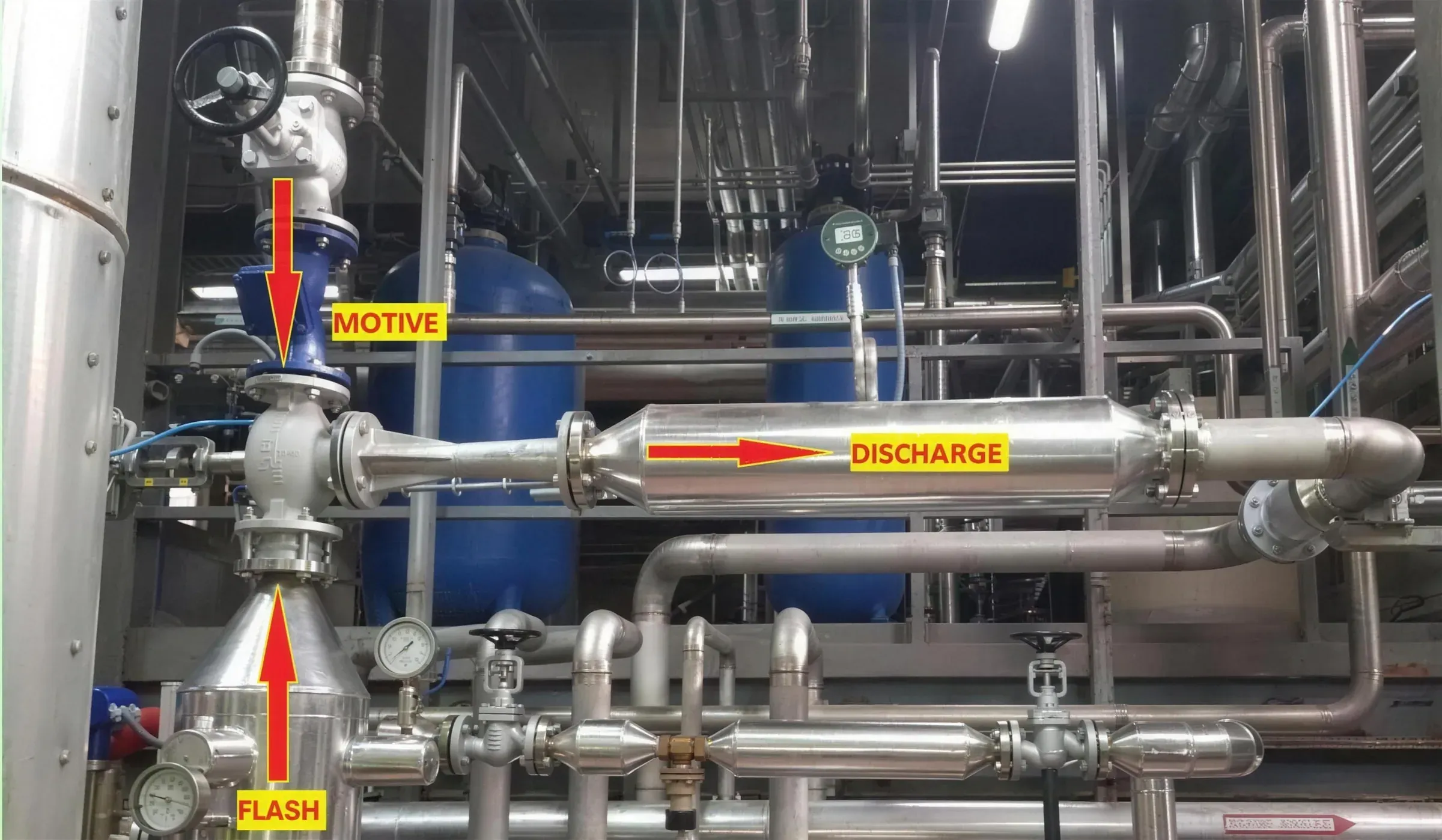
A steam-jet thermocompressor (the Jetomat) does the same pressure reduction through a nozzle instead of a valve seat. Motive steam from the higher main expands through the nozzle at high velocity, pulls in the low-pressure steam that was going to the vent, and the diffuser recovers the mixture to the pressure the consumer needs.
The pressure drop the plant already owns becomes the drive. Part of what the consumer receives is steam that was previously vented. (The general case, valve against ejector on any duty, is in Stop throttling, start recycling.)
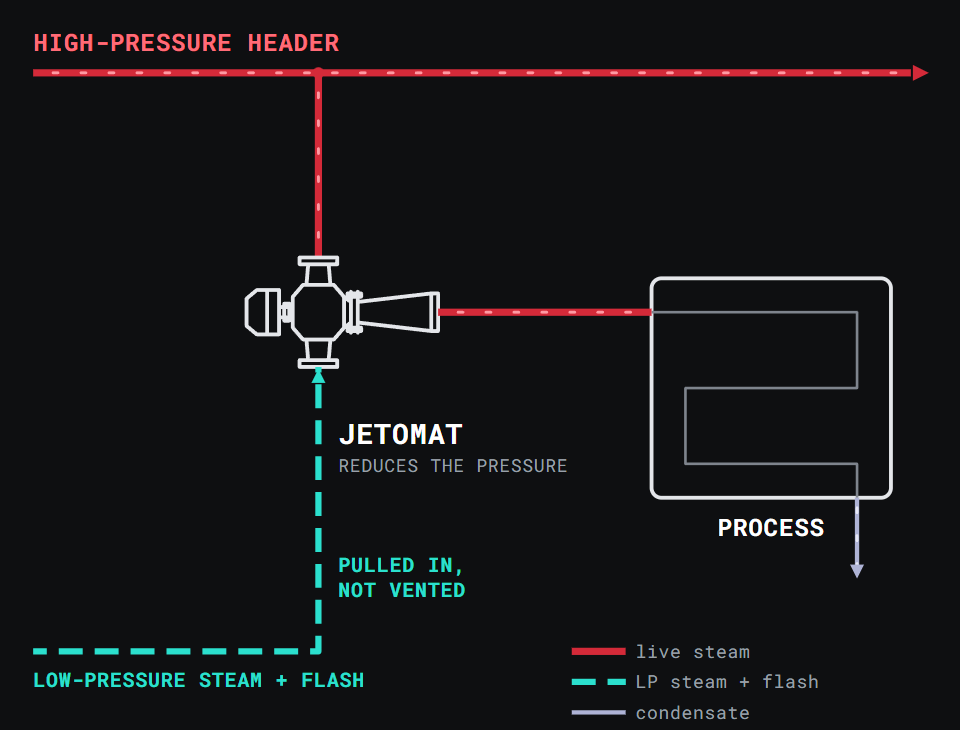
The nozzle in a Jetomat is variable: a spindle, positioned by its actuator on a 4–20 mA signal from the plant’s controller, opens and closes it as the demand moves. That matters in a chemical plant, where batches start and stop and the LP surplus changes hour by hour. A jet drilled for one duty point drifts off it as the load moves.
A worked example: half the delivered steam came from the vent
This is a documented refinery PRS duty, selected on Baelz’s tools.
- Headers: HP 42, MP 13 and LP 3 bar abs.
- Duty: a group of consumers needed 4 bar abs, fed by throttling MP steam through a pressure-reducing valve, while surplus LP steam was vented on the same site.
- The valve today: 10,500 kg/h delivered, all of it MP steam from the boiler.
- The ejector on the same duty: 5,247 kg/h of MP motive steam entrains 5,253 kg/h of the LP steam that was being vented, and delivers the same 10,500 kg/h at 4 bar abs.
One kilogram of motive lifts one kilogram of vented LP. The saving is half of the delivered stream, 5,253 kg/h, and the vent stops. The selection still entrained at 52 % of the design flow.
A second reference, from a petrochemical plant in Spain: two motorised variable-nozzle Jetomats in parallel take 19 bar g motive and lift 4.5 bar g steam into a 5.5 bar g header, 3.4 t/h and 1.6 t/h of it, for 5.4 and 2.5 t/h delivered. The reducing valves stay beside them.
Three things to check before you get excited
1. Is there a low-pressure surplus at all? The ejector needs suction steam that is being vented or wasted every hour it runs. If the LP header is balanced, the pressure-reducing valve is doing an honest job and the better question is a different one.
2. Is the duty big and steady enough for a turbine instead? A back-pressure turbine across a large, steady PRS duty makes power from the same pressure drop. One agrochemical group we work with chose an ejector on one header and a back-pressure turbine across three reducing stations on another, in the same year, because the duties were different. Pick per duty, not per brochure.
3. Have you budgeted for noise? Noise scales with the expansion ratio across the motive nozzle. The refinery station above expands about 4.3 to 1 and should be expected at 102–105 dB(A). Put acoustic lagging or an enclosure in the scope from the start.
“I am not touching my live header”
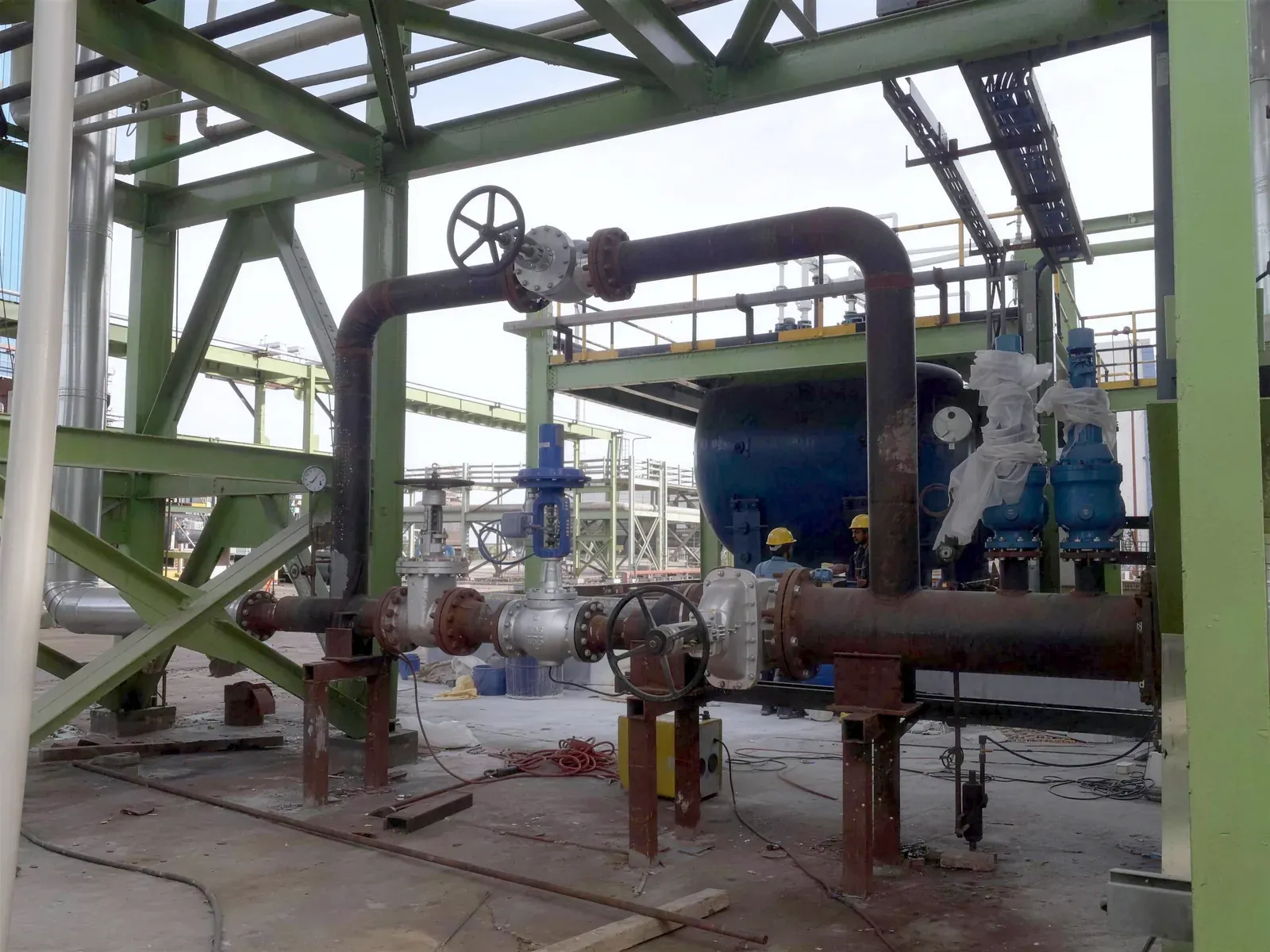
Nor would we. The reducing valve stays in place, in parallel, re-set to start-up and standby duty. The ejector is tied in beside it, proved against it, and only then given the running duty. Nobody needs to remove the old path on day one, and a proposal that does should be questioned.
The warm-up deserves more care than the tie-in. Bring a cold line up slowly, with a characterised warm-up valve and a written warm-up rate agreed before the shutdown.
Settle one question before the shutdown is planned: whether the tie-in is statutory steam-pipe work under the Boilers Act, 2025 and the Indian Boiler Regulations. It decides the drawings, the welders and the inspection, and so the schedule.
What we need from you
Send us your header pressures: HP, MP and LP, roughly what each one carries, and where the vents and flash drums are. That is enough to tell you what your PRS could be recovering, and whether an ejector, a turbine or nothing at all is the right answer.
FAQ
Does the reducing valve have to come out?
No. It stays in parallel, re-set for start-up and standby. The ejector takes the running duty and the valve covers anything the ejector cannot.
Is an ejector on a pressure-reducing duty noisy?
It depends on the expansion ratio across the motive nozzle. A large pressure-reducing duty can reach 102–105 dB(A) and needs acoustic lagging or an enclosure in the scope. A low-lift recirculation ejector runs at about 69 dB(A).
What do you need from us for a first answer?
The HP, MP and LP header pressures, roughly what each one carries, and where the vents and flash drums are.