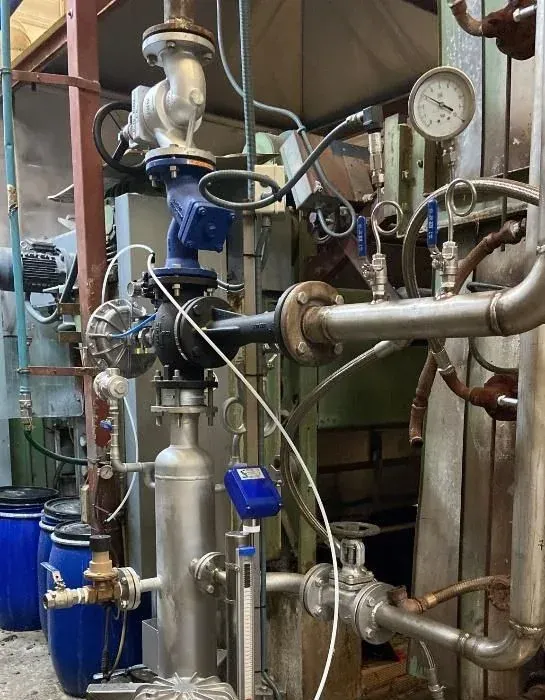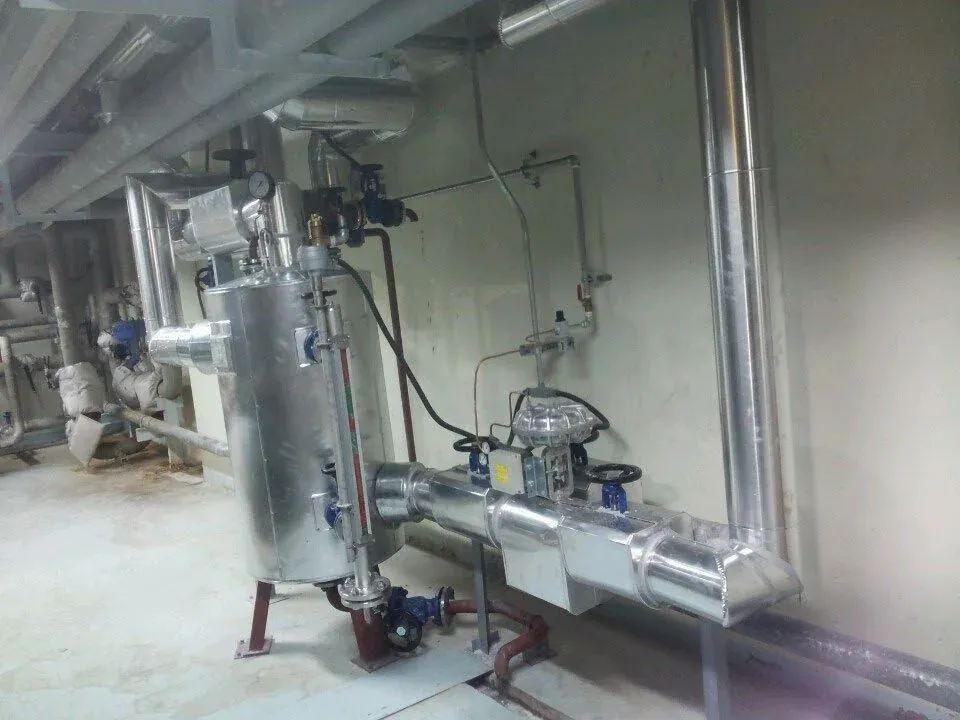
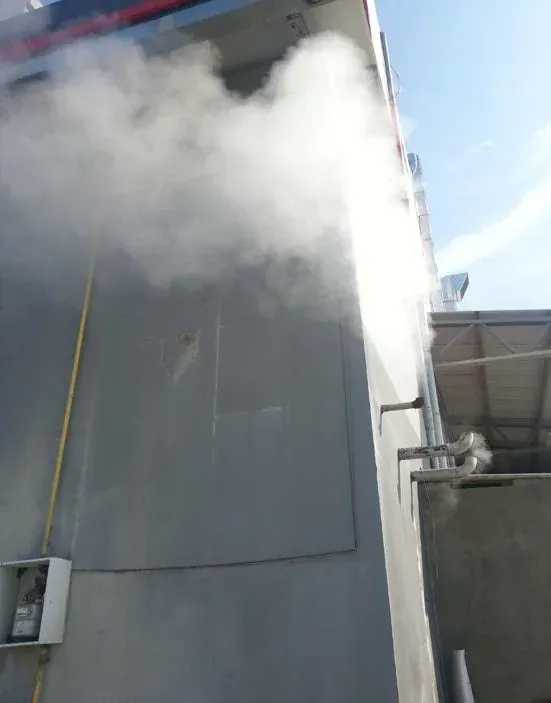
Original situation
Steam from the main fed every corrugator user (preheaters, single facers, double backer), each draining through its own steam trap. The condensate went to an open condensate tank, where its flash steam vented to atmosphere in a visible plume.
Technical enhancement
- The steam traps came out. Each group of users is fed by a Jetomat® (Baelz 590) driven by steam from the main.
- Each group drains untrapped into a separator, and the separator’s vapour is that Jetomat’s suction: a closed recirculation loop.
- At Plant 1, two Jetomats on the 13 bar g main take suction at 7.5 and 9.5 bar g and discharge at 8 and 10 bar g. Condensate cascades from the higher separator to the lower one, and a hot-water pump returns it to the boiler.
The result
Unit energy consumption (m³ per tonne of board), measured by the plants every month:
| Before | After | Change | |
|---|---|---|---|
| Plant 1 (Jun–Dec, 2018 vs 2019) | 35.75 | 26.81 | −24.75% |
| Plant 2 (Jan–Nov, 2017 vs 2018) | 22.96 | 18.08 | −21.2% |
- Lower in every month logged at both plants
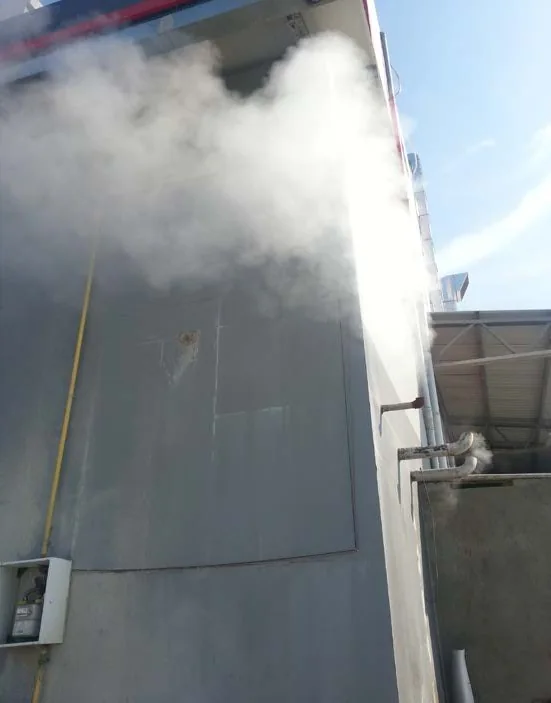
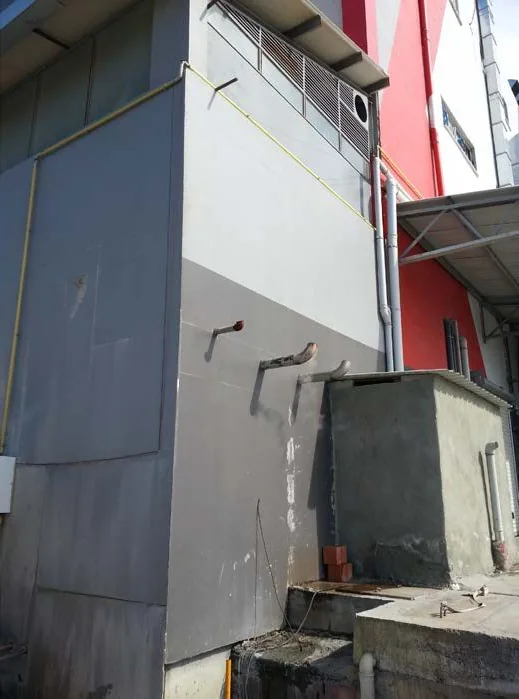
- The plume outside Plant 2 is gone
- Across 17 corrugator, paper and textile plants in Turkey with the same closed system (installed 2015–2023), the installation partner reports average savings of 20–45% and payback in 7–18 months
Why it works
A steam trap holds condensate back until it opens, so a film of condensate and air sits on the heating surface of the rolls and hot plates. In the closed cycle there are no traps: the Jetomat keeps a small, steady pressure drop across each group, steam blows through every user and sweeps the condensate out. The separator’s vapour goes back to the Jetomat instead of a vent, and the hot condensate goes back to the boiler.
Takeaway
Two plants, two years of monthly logs, the same answer: a corrugator without traps, on a closed Jetomat loop, puts about a fifth to a quarter less energy into every tonne of board.