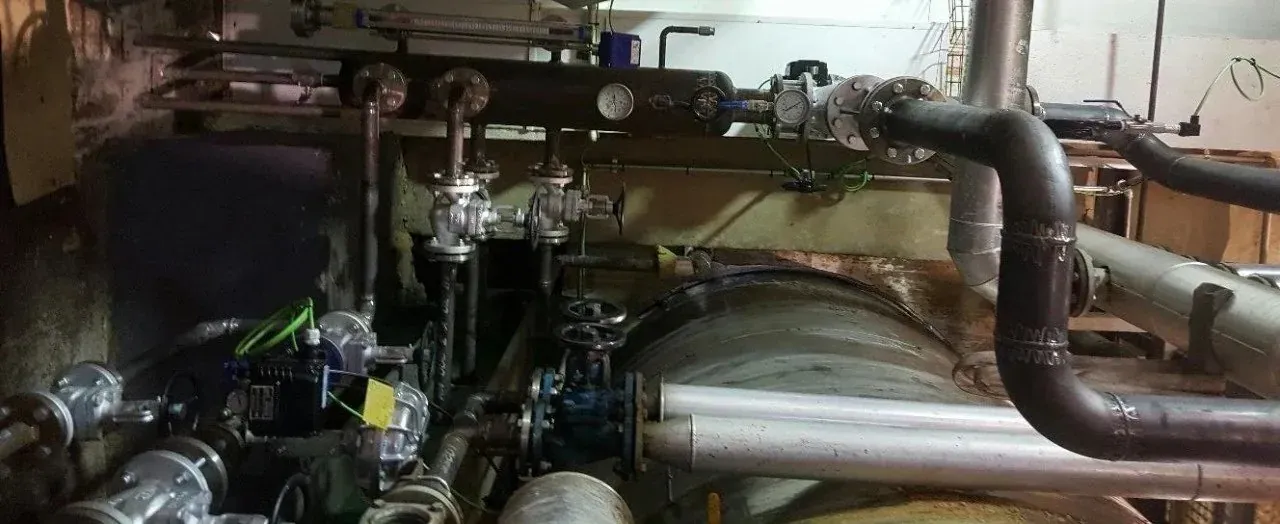
Original situation
Steam from a 10.8 bar g header fed three cylinder dryers and two hot presses, each draining through a steam trap. The condensate collected in a flash vessel at 4.9 bar g; its flash steam went to the feed-water tank and a pump returned the rest to the boiler, which fired bunker-C oil.
Technical enhancement
- A Jetomat® (Baelz 590) takes header steam as motive and supplies the dryers and presses at 9.8 bar g.
- The steam traps came out. Every machine drains straight to the flash vessel, now at 9.3 bar g.
- The flash vessel’s steam is the Jetomat’s suction: a closed recirculation loop. A pressure controller on the discharge sets the Jetomat.
- In service since 25 December 2003.
The result
| One month each | January 2003 | January 2005 |
|---|---|---|
| Fuel oil per boiler hour | 174.0 L | 131.2 L (−24.6%) |
| Board per litre of oil | 32.7 m² | 42.9 m² (+31%) |
| Monthly output | 1,478,560 m² | 1,588,929 m² (+7.5%) |
| Water supply (before: March 2003) | 1,258 L/h | 246 L/h (−80%) |
- About 4 months payback, as calculated by the plant on the saving per m² of board
- No trap maintenance on the dryers and presses
Why it works
Cylinder dryers and hot presses stay hot only while steam keeps moving through them and condensate keeps leaving. With the traps gone and the Jetomat lifting the flash vessel’s steam back to 9.8 bar g, steam flows through every machine continuously and the heat in the flash steam goes back to the machines instead of the feed tank. The boiler fires less oil for more board.
Takeaway
On a corrugator the flash steam is the cheapest steam in the plant. Send it back to the dryers and presses through one Jetomat, take the traps off, and the fuel bill falls while the line runs more board.