
Valve vs. Ejector: A Lifecycle Cost Comparison for Steam Systems
INTRODUCTION
Steam is one of the costliest utilities in Indian plants—across Paper, Food & Beverage, Textiles, Chemicals and more. If your lines still use throttling Control Valves plus many Steam Traps, you’re paying for pressure to be dropped…and often paying again when Flash Steam is vented. Jetomat Steam Jet Ejectors the opposite: they Recycle low-pressure vapor back into useful supply.
This post compares the Total Cost of Ownership (TCO) over Five Years, for a conventional valve-and-trap loop versus a Jetomat ejector upgrade. You’ll see how Saving Energy (often 10–30%) and minimal maintenance produce fast payback and a clearly lower lifecycle cost.
WHAT EXACTLY ARE WE COMPARING?
Traditional setup
Pressure-Reducing Valve (PRV) throttles 12–15 bar steam down to 3–6 bar (exergy lost).
Multiple Steam Traps, a vent/flash tank, often a Steam Separator.
Energy path: throttle → create Flash Steam → vent or partially recover.
Maintenance: trap surveys, replacements, valve/actuator overhauls, leak management, downtime.
Jetomat Ejector Setup
Steam Jet Ejector sized to entrain low-pressure vapor/flash and Re-pressurize it to the user setpoint.
Works via engineered Variable Nozzle Design and Diffuser and Nozzle section
Behaves like a non-rotating Steam Compressor built into your Heating Systems.
Simplifies the loop (fewer traps), forming an in-line Heat Recovery System.
TYPES
1) Valve + Traps
Control Element: PRV only Drops Pressure (energy lost).
Condensate Handling: many traps; cycling causes temperature swings, thicker Steam Condensate films, and occasional waterlogging.
Ancillaries: flash tank/vent, Steam Separator (layout-dependent).
Effect: lower heat flux, more maintenance, and recurring losses.
2) Jetomat Steam Thermocompressor
Control Element: Steam Jet Compressor entrains low-pressure Flash Steam, mixes with motive steam; the Diffuser lifts the pressure to your setpoint.
Condensate & Vapor: continuous entrainment forms a Condensate and Flash Steam Recovery System; trap count often collapses.
Effect: higher internal steam velocity, improved Heat Transfer Solutions, flatter temperatures, steadier control.
Design Note: correct Thermocompressor Design (motive/suction/mixed pressures) is essential.
BENEFITS
Energy: Compression-mode ejectors regularly save 10–30% vs throttling—bigger where vent plumes are present.
Maintenance: Ejectors Have Robust Design to withstand water hammer; fewer traps = fewer failures, less survey time, lower spares.
Quality & Throughput: Thinner condensate films and uniform temperatures reduce rejects (warp, wet spots) and support higher speeds.
Industries:
Paper/Corrugated: preheaters, hot plates, dryer groups.
Food & Beverage: evaporators, reboilers, cookers (dairy, beverages, edible oils, sugar, etc.).
Textile: drum dryers, stenters, wash ranges.
ROI: Indian plants often see Payback in Months, because the ejector simultaneously cuts fuel, water & chemicals, and maintenance.
A 5-YEAR LIFECUCLE COST COMPARISON
Assumptions (one line/zone)
• Operating: 8,000 hours/year
• Steam Cost (fuel + water + chemicals): ₹2,500 per ton (replace with your plant’s weighted average for coal/biomass/CNG, water & dosing)
• Baseline Steam Use for this user: 10,000 t/year (1.25 TPH) → ₹2.50 crore/year energy
• Ejector Energy Saving (mid-case): 20% → saves 2,000 t/year → ₹50 lakh/year
• Maintenance (baseline): ₹12 lakh/year (trap surveys, PRV/actuator service, leak fixes)
• Maintenance (ejector): ₹3 lakh/year (inspection/controls; no rotating internals)
• Downtime/quality Delta: ₹4 lakh/year improvement with ejector
• Capex (installed): PRV+traps refresh ₹12 lakh (status-quo); Jetomat ejector retrofit ₹50 lakh
YEARLY CASH FLOWS (OPEX)
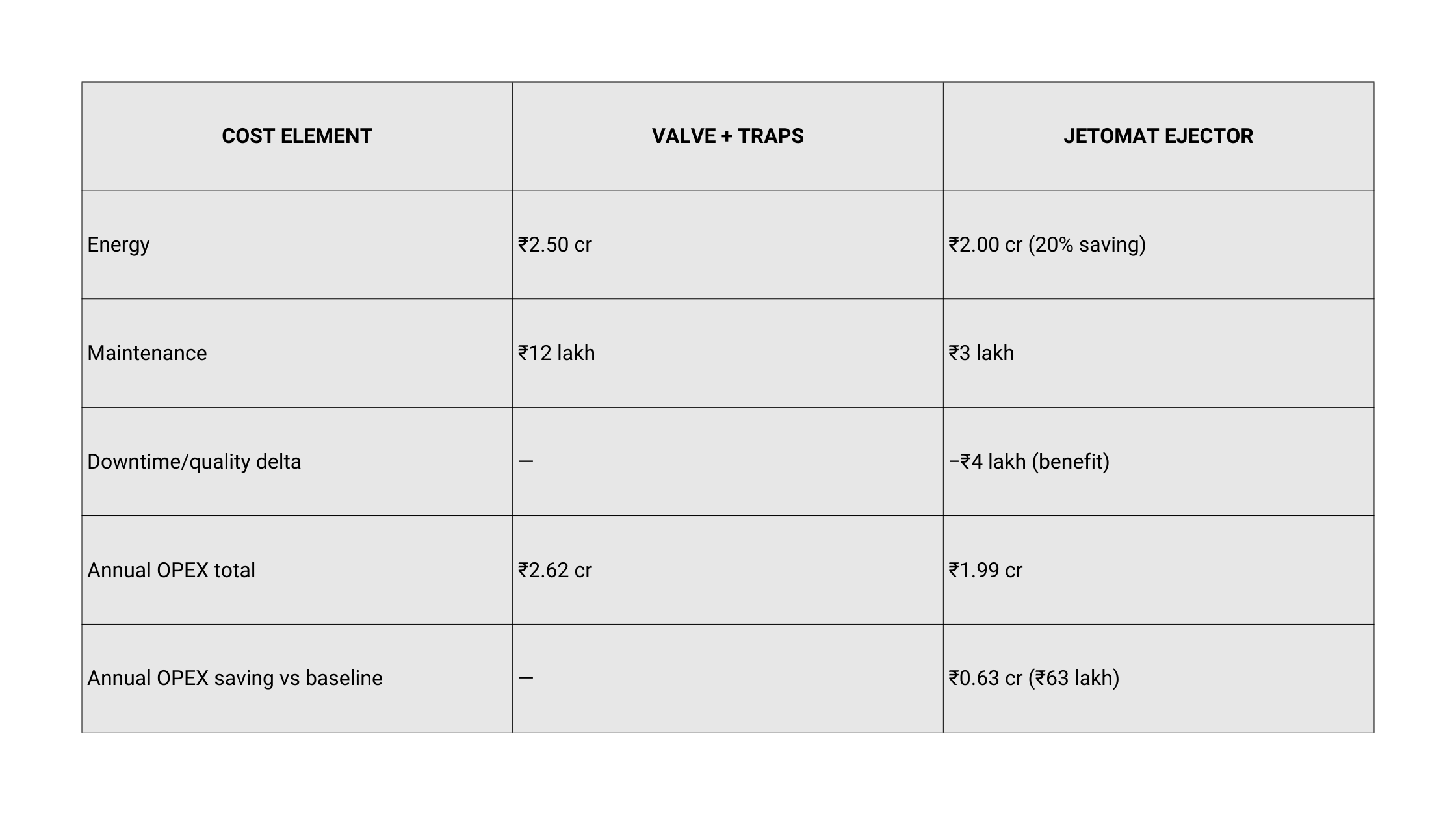
Capex at Year 0: Valve refresh ₹12 lakh vs Ejector ₹50 lakh → incremental capex = ₹38 lakh.
Simple Payback (Incremental)
₹38 lakh / ₹63 lakh ≈ 0.6 years → about 7–8 months
5-Year TCO (Undiscounted)
Valve Path: Capex ₹12 lakh + 5 × ₹2.62 cr = ₹13.22 crore
Ejector Path: Capex ₹50 lakh + 5 × ₹1.99 cr = ₹10.45 crore
Five-Year Advantage With Ejector: ₹2.77 crore lower TCO (for one line/zone).
Sensitivity
Only 10% Energy Saving: annual OPEX saving ≈ ₹38 lakh; payback ≈ 1.0 year; 5-year TCO better by ≈ ₹1.52 crore.
30% Energy Saving: annual OPEX saving ≈ ₹88 lakh; payback ≈ ~5 months; 5-year TCO better by ≈ ₹4.02 crore.
Higher Steam Cost (e.g., volatile gas/coal prices): savings scale Linearly—payback gets even faster.
Tip: If your current steam cost is ₹3,000–₹3,500/t (PNG/coal mix, water and dosing included), the savings numbers increase proportionally.
WHY THERMOCOMPRESSOR WIN ON LIFECYCLE COST
Recycle, Don’t Throttle: PRVs Drop pressure; ejectors Re-pressurize Flash Steam into useful mixed steam.
Higher Steam Velocity: Thinner condensate films → stronger Heat Transfer Solutions, flatter temperature profiles.
Simpler Loops: Continuous entrainment Reduces Traps and vents, essentially embedding a Flash Steam Recovery System into the process.
Reliability: The Thermocompressor working principle relies on a variable nozzle and diffuser—1 moving part—so failures and maintenance drop.
Controls-Friendly: Hold mixed-steam pressure (or temperature); easy DCS/PLC integration across your Steam Equipment.
INDIAN USE CASES
Paper & Corrugated: Upgrading preheaters/hot plates/dryer groups with Steam Jet Thermocompressors commonly cuts steam 15–32%, stabilizes moisture/temperature, and lowers trap maintenance—ideal for high-speed board lines meeting short lead times.
Food & Beverage: On evaporators/reboilers, ejectors act as in-line Steam Compressors, recompressing secondary vapor to cut fresh-steam draw—often delivering Payback in Months, especially with Fuel price volatility.

Jetomat Thermocompressor
CONCLUSION
Look Beyond Capex—Lifecycle Cost Wins the Argument. While a Jetomat ejector is a modern investment, its 10–30% Energy Savings, simpler loops, and low maintenance typically deliver Excellent ROI and a Lower 5-year TCO than PRVs + traps.
Screen Candidates (Gemba Walk): Where do you throttle >3–4 bar and see vent plumes or heavy trap loads?
Measure & Model: Header/mixed/suction pressures, vent rates, production KPIs; estimate energy & maintenance deltas in ₹.
Engineer the Ejector: Select Thermocompressor Design (motive/suction/mixed), tie-ins, and controls.
Pilot One Zone: Prove savings & stability in 2–4 weeks; document before/after OPEX in ₹/month.
Scale Up: Standardize across similar users; roll into a sitewide Heat Recovery System strategy.
WANT A QUICK, NUMBERS-FIRST CASE?
Share your last 6–12 months of Steam and Condensate data. We’ll build a tailored 5-year TCO and propose the right Jetomat Steam Jet Ejector configuration to start Saving Energy—this financial year.